


The FAR Overhaul became effective across much of the Federal government last week. And with that came the setup for a big catastrophe, an inevitable train wreck taking place in slow motion.
Here’s how the disaster will happen under the new FAR Overhaul.
A small business gets a big multiple-award contract, an IDIQ. Let’s assume that IDIQ was not restricted to small businesses in any way. That small business does really well, maybe because of the IDIQ. So it grows to become a large business. Then that now-large business wins a blanket purchase agreement on the IDIQ. An agency sets aside work on the BPA for small businesses to compete for.
Multiple small businesses bid for the agency’s set-aside work. Yet the large business wins the work. The small businesses wasted their time bidding on the set-aside.
This is bad. It’s unfair to the other small businesses competing. The work went to a large business on the basis that it used to be small. That seems counter to the concept of a set-aside. Is it allowed?
Here’s the worst part: There is no answer. No one can confidently say what will happen in this scenario. And that’s because the FAR Overhaul says one thing, and the SBA says another.
Which one is right?
The SBA Inspector General’s 20-year crusade
SBA has the stricter rule, but the SBA’s rule didn’t come about organically. The agency had to be pushed.
Starting in 2005, the SBA Office of Inspector General started sounding the siren about large businesses winning small-business contracts. “Procurement flaws allow large firms to obtain small business awards and agencies to count contracts performed by large firms towards their small business goals,” the SBA IG reported.
Large firms obtain small business awards. The actual facts were scandalous—at least by early 2000s standards. Verizon reportedly won $107 million in small-business contracts. Raytheon got small-business money too.
The SBA IG had found a cause to fight for. The issue of large businesses winning small-business contracts became the IG’s #1 “serious management” challenge. It stayed at #1 for fifteen years. Only in 2021 did the large-business issue get dethroned by COVID loan fraud. Even then, the cause went down just one spot to #2.
SBA’s contracting policy was profoundly affected by the IG’s crusade. In part because of pressure from the IG, SBA issued a merger-and-acquisition recertification rule. I discussed the latest iteration of that rule in a recent post:

SBA also published a series of other recertification rules, each with its own exceptions and contingent scenarios. The current version is 19 paragraphs long. It has a whole subsection dedicated to exceptions.
But, even with those changes, the IG kept up the crusade. Plus, an outside watchdog, the American Small Business League, repeatedly sued SBA on the issue. This went on for 20 years. That’s 20 years of SBA getting beaten up for small-business contracts going to Verizon and Raytheon.
It didn’t stop until SBA published the current recertification rule.
The FAR Overhaul vs. SBA’s recertification rule
SBA’s recertification rule now prohibits, in that first scenario, the now-large business from winning the work. If the original contract isn’t set-aside, the firm must be small to win set-aside orders. Not just small for the contract—which might have been years ago—but small for the order, for the work itself.
That change was enough to satisfy the SBA IG. In 2025, the SBA IG finally took the large-business issue off the list of top SBA management challenges. It was because of that change to the recertification rule.
And for a short, glorious period, the FAR mirrored SBA’s change. Both sets of rules agreed—large businesses shouldn’t get small-business work. That was February of last year.
But, in September, the FAR Overhaul changed it back. In a nod to the Overhaul’s simplicity ethos, the Overhaul’s recertification rule is much shorter. It’s hardly a rule at all, and the result is that large businesses (if they used to be small) can win small-business work:
A business that represents as a small business concern at the time of its initial offer for the contract (whether or not the offer includes price or the price is evaluated (see 13 CFR 121.404(a)(1)(iv)), is considered a small business concern for each order issued under the contract.
This was, in a word, breathtaking. This sort of territorial swordfighting doesn’t happen often in procurement policy. After the IG’s 20-year crusade, the SBA rule now states that a small business has to be small at the order (with lots of caveats, the main one being that the contract itself was not set aside). The overhauled FAR rule doesn’t say that. The FAR—which just eight months before had adopted the SBA rule—now says that the business only needs to be small for the overall contract.
There’s no Tenth Amendment in procurement policy. So this isn’t JB Pritzker vs. ICE, with a tiebreaker to the states. There isn’t a clear winner in FAR vs. SBA.
Leave it to the courts
If Kalshi opens this battle up to betting, I’d give a slight edge to SBA. The main reason is the sequence a case would need to follow.
Because recertification really gets to whether the company is small, SBA’s OHA would get to rule first. I wrote about OHA two weeks ago as the office that hears 8(a) suspension appeals:
OHA also hears size appeals. I’ve appeared as the lawyer in 55 published OHA appeals, and most of them are size cases. In size cases, OHA follows SBA rules.
But OHA is not the last word. If the large business loses at OHA, the business can go to court. There are a couple of court cases favoring SBA’s rules over the FAR. It’s not certain that those cases would control, though.
One factor might be the depth of explanation. SBA’s recertification rule was developed over 20 years. Each time, SBA explained why it was changing the rule, received hundreds of pages of comments, and then explained the rule again. There are likely thousands of pages of explanation between the SBA commentary and the public comments.
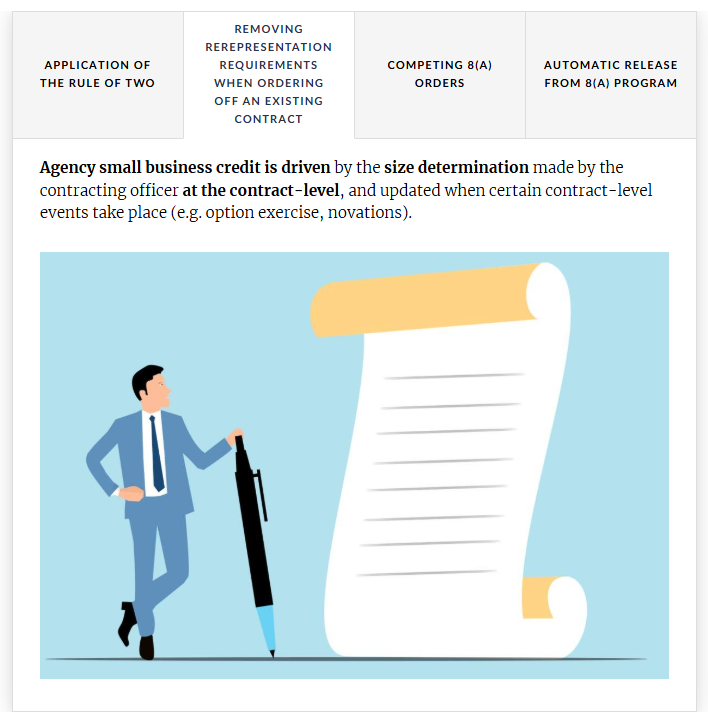
The FAR Overhaul’s explanation is basically a sentence, plus Don Draper against a blue background, holding an oversized pen and staring aggressively at a seven-foot scroll:
It’s also relevant to this discussion that the SBA Administrator has staked her reputation on combating fraud and abuse in government contracting. Just yesterday, the SBA suspended 150 D.C.-area contractors for, in essence, winning a lot of contracts. Those firms, some would argue, were just good at contracting; they weren’t abusing the system. Here’s what’s abusive: large businesses winning small-business contracts.
Maybe that’s what the FAR Overhaul says can happen. But read the law: The SBA Administrator has the authority to “determine within any industry the concerns, firms, persons, corporations, partnerships, cooperatives, or other business enterprises which are to be designated ‘small-business concerns’ for the purpose of effectuating the provisions of this Act.” In otherwords, for size, what SBA says goes.
But let’s say the FAR Overhaul prevails. The large business wins. Then what? Prepare for disappointed small businesses, more uncertainty, and lots of protests.
With 20 years of Federal legal experience, Sam Le counsels small businesses through government contracting matters, including bid protests, contract compliance, small business certifications, and procurement disputes. His website is www.samlelaw.com.
This article is for informational purposes only and does not constitute legal advice.