In this live stream, I analyzed the newly pre-published SBA’s proposed rule that changes the social-disadvantage eligibility criteria for the 8(a) program. Viewers had questions on the proposed rule. We also covered the little-discussed DoW Small Business Bill of Rights, a recent reorganization of staff at SBA, and a few cases involving the mentor-protégé program.
Links and an auto-generated transcript follow. Subscribe to GovCon Intelligence to be notified of future live streams.
Links
SBA pre-publication proposed rule on “Reforms to Remove SBA’s 8(a) Program’s Rebuttable Presumption of Social Disadvantage for Individually Owned Firms Only; Reforms Do Not Impact Entity-Owned Firms” https://public-inspection.federalregister.gov/2026-11765.pdf
NDAA FY24 (see section 876 for Small Business Bill of Rights) https://www.congress.gov/118/plaws/publ159/PLAW-118publ159.pdf
DoW Small Business Bill of Rights https://business.defense.gov/Small-Business-Bill-of-Rights/
PDF of Small Business Bill of Rights https://business.defense.gov/Portals/57/Small%20Business%20Bill%20of%20Rights/DoW%20Small%20Business%20Bill%20of%20Rights.pdf?ver=TGSweXAuiLJkOqERHfZKkw%3d%3d
DoW Small Business Bill of Rights one-pager https://business.defense.gov/Portals/57/Small%20Business%20Bill%20of%20Rights/Small%20Business%20Bill%20of%20Rights%201-Pager%2003.11.26%20-%20fillable.pdf?ver=WOh6YHb4fg84cZg0o1OXYA%3D%3D
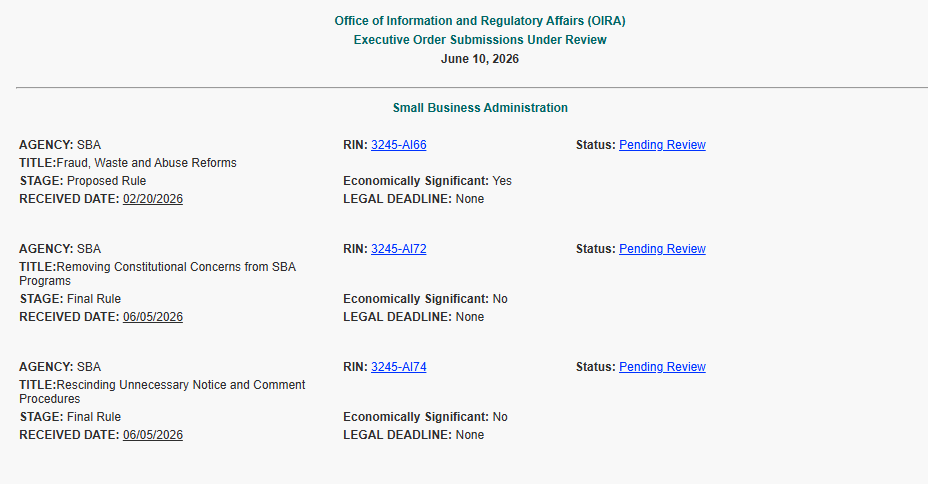
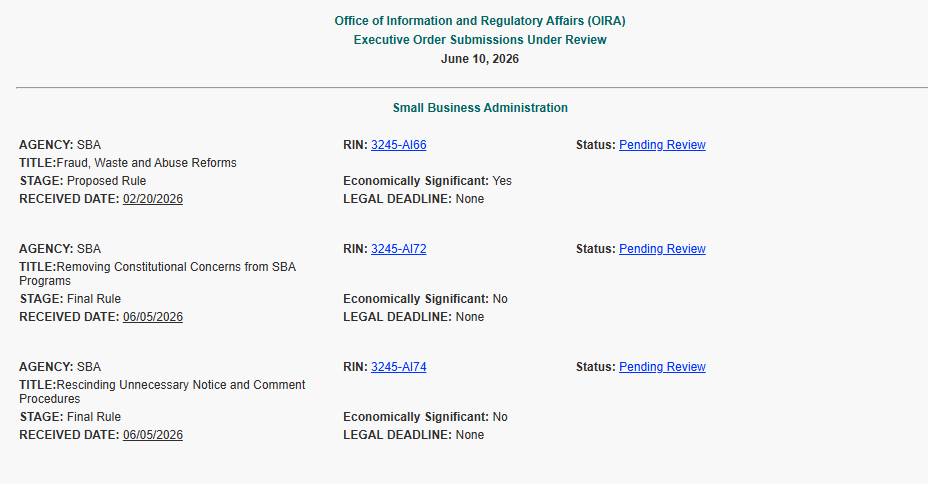
SBA policies under review at the Office of Information and Regulatory Affairs https://www.reginfo.gov/public/do/eoReviewSearch
SBA news release: “SBA Announces Agency-Wide Reorganization to Modernize, Drive Operational Efficiency, and Enhance Accountability to Taxpayers” https://www.sba.gov/article/2026/06/05/sba-announces-agency-wide-reorganization-modernize-drive-operational-efficiency-enhance
SBA OIG news release: “Government Contractor and Executives to Pay $21.3M to Resolve Fraud Scheme Involving Service-Disabled Veteran-Owned Small Business Contracts” https://www.sba.gov/article/2026/06/09/government-contractor-executives-pay-213m-resolve-fraud-scheme-involving-service-disabled-veteran
COFC decision on timing mentor-protégé joint ventures: Primary Healthcare LLC d/b/a Anglin Distinctive Health Care JV LLC v. United States, Case No. 25-1795C (2026). https://ecf.cofc.uscourts.gov/cgi-bin/show_public_doc?2025cv1795-40-0
COFC decision on mentor standing: Int’l Bus. Sales & Servs. Corp. v. United States, Nos. 26-401 & 26-425 (Fed. Cl. May 29, 2026). https://ecf.cofc.uscourts.gov/cgi-bin/show_public_doc?2026cv0401-48-0
GAO decision on subcontractor joint-venture past performance: ID8Spark, LLC, B-424253.2, .3, .5, May 18, 2026. https://www.gao.gov/assets/890/886345.pdf
FAR Overhaul proposed rule status: https://www.acq.osd.mil/dpap/dars/opencases/farcasenum/far.pdf
Number of 8(a) participants below 3,000:
Chapters
00:00 - Introduction to GovCon Intelligence
00:52 - SBA Proposed Rule on 8(a) Social Disadvantage
08:00 - Impact of the Proposed Rule on Current 8(a) Firms
11:13 - Group Classification and Historical Context under the New 8(a) Rule
18:12 - Delays in Processing New 8(a) Applications
19:54 - New vs. Old Application Evidence
20:40 - Department of War Small Business Bill of Rights
26:21 - Upcoming SBA Policy Changes and OIRA Reviews
30:16 - SBA Agency-Wide Reorganization and Workforce Reductions
33:20 - SDVOSB Fraud Case: Broadway Electric and Cornerstone Contracting Settlement
37:13 - Court of Federal Claims Case: Primary Healthcare (Mentor-Protégé Joint Venture Timing)
43:13 - Court of Federal Claims Case: International Business Sales and Services Corporation (Mentor standing)
45:08 - GAO Case: ID8 Spark (Subcontractor and Joint Venture Past Performance)
47:19 - FAR Overhaul and Notice and Comment Phase Updates
49:45 - Tracking the Latest 8(a) Active Firm Data
52:03 - Business Activity Targets (BAT) and Closing Remarks
Transcript
Introduction to GovCon Intelligence
Welcome to GovCon Intelligence. I’m your host, Sam Le. It’s a solo episode today.
I’m going to be going over SBA’s proposed rule on changes to 8(a) eligibility. But that’s not the only news that we’ll be going over today. There is big news out of the Department of War on the Small Business Bill of Rights. That’s a good benefit to small businesses, but DOW is not really talking about it. It gives a new avenue for small businesses to get information from DOW, as well as to file complaints with the department if they have complaints.
There’s also been a reorganization within SBA; we’ll go over that. We will also cover some fraud cases and cases out of GAO and the Court of Federal Claims. I’ll also take a look at the latest 8(a) data on the suspensions and the number of companies in the 8(a) program. So, thanks for joining us for this solo episode.
SBA Proposed Rule on 8(a) Social Disadvantage
I’ll start with the proposed rule that SBA has put out on pre-publication today. It actually gets published officially tomorrow, June 11th, and it’ll have a 30-day comment period. The comments will be due July 13th, actually, because July 11th falls on a Saturday. So, we will get 30 days to process this.
But it’s really just a change to one rule. I think 30 days is a decent amount of time to figure out what’s going on here. The proposed rule is called “Reforms to Remove SBA’s 8(a) Program’s Rebuttable Presumption of Social Disadvantage for Individually Owned Firms Only. Reforms do not impact entity-owned firms.”
Yes, they actually put that statement in the title of the rule: “Reforms do not impact entity-owned firms.” So, very clearly, this only applies to individual-owned firms—firms owned by individual applicants. This changes the, as the title suggests, the rebuttable presumption of social disadvantage for the 8(a) program.
It could have been broader. We were potentially looking at changes that might occur for economic disadvantage, potential for success, or maybe business activity targets within the 8(a) program. This rule does not touch those other areas. This proposed rule is only about social disadvantage. To get into the 8(a) program, you need to have social disadvantage, economic disadvantage, potential for success, and good character.
This rule is only about that first part. It’s only about social disadvantage within the 8(a) program. This comes after a three-year period where SBA has been trying to grapple with the Supreme Court’s decision in the affirmative action cases—the one involving UNC and Harvard, Students for Fair Admissions—as well as a district court case out of the Eastern District of Tennessee.
That case was called Ultima Services. Ultima Services specifically dealt with the SBA’s use of the social disadvantage rebuttable presumption. SBA goes through some of the history of that. Apparently, it came out in 1986 until its “demise” in 2023, according to this case. The rebuttable presumption of social disadvantage essentially said that there are five groups that do not have to establish their individual disadvantage.
Right now, as many of you know, you have to write a narrative to get into the program. You have to say how you, as an individual, suffered discrimination or social disadvantage. Under the rebuttable presumption, people in those five groups did not have to write that sort of narrative. The five groups were Black American, Hispanic American, Asian Pacific American, South Asian American, and Native American.
If you were in one of those five groups under the social disadvantage rebuttable presumption, you could just self-certify and say, “Hey, I’m in this group,” and then you could get into the program under social disadvantage. You still had to comply with the other requirements: economic disadvantage, potential for success, and good character, but social disadvantage was taken care of for those five groups.
Since 2023, SBA has not used that rebuttable presumption. Instead, they’ve put in place a narrative process where individuals have to write up their own individual disadvantage. Why were you, as an individual, discriminated against? Then SBA reviews that narrative to decide whether you get into the program, or for companies that are already in the program, how you stay in the program.
Now, SBA is going to replace that narrative process. It may not be exactly what’s in this proposed rule; this is still going to be out starting tomorrow for a 30-day comment. But very clearly, SBA is going to change that process so that the narrative is not that individual social disadvantage.
The big emphasis in this proposal is showing discrimination against a group by a government or a private entity. This is a bit different from saying, “Oh, there’s cultural discrimination,” or “There’s social discrimination.” You have to pinpoint discrimination from a Federal, state, or local government, or a university or corporation—so in general, a government or a private entity.
That discrimination has to be within the applicant’s lifetime. It says that the discrimination “must be within his or her lifetime” “by a Federal, state, or local government, university, or corporation” through a specific action. That’s another element. It refers to an “action, policy, rule, regulation, or other practice of any of the agencies, subsidiaries, or authorized agents.”
This is very different from the narratives that people have been submitting in the past. Previously, the narrative was—I used to refer to it as the three Es—you had some sort of discrimination in employment, education, or entrepreneurship (business ownership).
Now, if this proposed rule becomes final, you have to show that you are part of a group that has been discriminated against within your lifetime by a government or a private entity. There is an element of self-certification of group membership, but in addition to those three elements, you have to show material harm, and that seems to be specific material harm to the individual.
It’s referred to throughout the rule as a citizen. It’s always been the case that you have to be a citizen to get into the 8(a) program, and so now this rule refers to the individual as a citizen. The citizen must establish that the discrimination, bias, or favoritism conferred material harm on the citizen.
We are talking about a very, very different structure than what SBA had before. You saw many people writing narratives during this three-year period starting in 2023, saying, “I’m in a particular industry that discriminates against women,” or “discriminates against people with disabilities,” or “my industry in general is very unwelcoming to a particular race or ethnicity group.”
Under this proposal, based on what I’m reading, you have to identify a particular government or private entity that is engaged in discrimination, and it can’t just be historical discrimination. It can’t be from 100 years ago or so; it has to be during the citizen’s lifetime. Those are the big changes here.
Impact of the Proposed Rule on Current 8(a) Firms
Now, a big question has come out: Does this apply to present firms that are in the program? If you are one of—I’m going to go over some of the stats later—but if you’re one of the, say, 3,000 companies that are in the program, are you going to have to meet this standard?
First of all, it’s clear that this does not apply to entity-owned firms. That’s in the title of the proposed rule: “Reforms do not impact entity-owned firms.” There’s a strange sentence where it says SBA “would not apply the new test to current participants at their next annual review.”
You wouldn’t have to do it at your next annual review, but it kind of suggests: Does that mean that you would have to do it at the annual review after that, so maybe two years from now? Are you going to have to go through that? SBA does seem to indicate later on in the document, if you go into the cost-benefit analysis, there’s a sentence that says, “This rulemaking does not affect participants currently admitted to the 8(a) BD program.”
That sentence is not in the regulatory text itself, so I don’t know that you could take it to court. Maybe you could. It is from the SBA, signed by the Administrator. But first of all, it’s not in the actual regulatory text.
However, there is this indication in the cost-benefit analysis that the rulemaking does not affect participants currently admitted to the 8(a) BD program, suggesting that if you’re in the program right now and maybe you could not qualify under this new standard, you’re going to be able to remain in the program.
It’s not going to be like the post-Ultima state of events where everybody had to reapply under the new standard. After Ultima, companies still remained in the program. But that would be a good area to submit comments on during this 30-day, actually 32-day comment period, because otherwise it would end on a Saturday.
Group Classification and Historical Context under the New 8(a) Rule
So, how is this actually going to work? SBA has made a big to-do about getting rid of the narrative, stating it’s not going to be an individual narrative. It does seem like there’s still going to be a lot of writing involved in this. What might happen is that if you’re a member of a particular group—and I’ll name a few groups that I think might be able to get in under this standard—maybe there will be organizations, nonprofits, or trade organizations that might be able to identify the necessary discrimination by a governmental or private actor to justify that group as a whole. We still have this group basis, but then there’s additionally the requirement that the applying citizen establish material harm.
That part of it is not particularly defined. There’s a lot in here about what sort of groups might qualify and how they would qualify, but the material harm is really just defined as loss of access to or diminished opportunities related to economic advancement. There’s not the same level of detail that SBA used to have with those three Es of employment, entrepreneurship, and education.
You have less specificity on what exactly qualifies as material harm. The SBA gives some examples of how groups would qualify. You self-identify as part of a group, and their first example is the previous rule—the previous social disadvantage rule prior to Ultima. They reference the “prior iterations” of this rule, 13 CFR 124.103, that “excluded the citizen’s racial or ethnic group as a group entitled to a rebuttable presumption of social disadvantage.”
What they’re really saying there, and actually it says somewhere in this document, is that under the previous rule, both the text and its application—this is a quote from SBA—”rendered White Americans almost totally unable to participate in the program.”
SBA says that under the previous rule, because it had the five identified groups (Black American, Hispanic American, Asian Pacific American, South Asian American, and Native American), it made White Americans almost totally unable to participate. I don’t know that to be true. I know that there may be segments of White America that were not able to get into the program.
But if you look at the statistics, there are a lot of service-disabled veterans in the 8(a) program, potentially because they applied under disability. I wrote a note at some point pointing out that. Women were able to write narratives and get in, a lot of them saying, “I’m in an industry that discriminates against women.”
There are not many women construction company owners. Also, people of Jewish faith—Jewish Americans—were able to get in. That actually used to be one of the examples that SBA used on how you would be able to establish social disadvantage.
So, I’m not sure that it’s true that all segments of White Americans were almost totally unable to participate, but that is the statement that SBA makes. Clearly, that is the example that SBA is thinking of when they’re saying, “Here’s a group that the prior version of this regulation excluded as entitled to a rebuttable presumption of social disadvantage.”
But that’s not the only group that was not in that list of five, by the way. It’s not just that White Americans were not in that group of five. When I was at SBA, there was some movement to include persons of Middle Eastern or North African descent (MENA), particularly because post-9/11, most people would agree there was clearly discrimination against people of Middle Eastern and North African descent.
Some of that still exists today. So, that’s another group that was not under the rebuttable presumption—Middle Eastern and North African descent—that could potentially qualify under the SBA example. Additionally, you have to point to specific government or private entity actions.
One thought that came to mind is the countries that are on the travel ban. There are a lot of countries now under a travel ban, and that is a government action. Now, you’d have to make a showing about the material harm to the individual and show the discrimination. That may be a hard case to make now, but maybe in the future, you could say, “Well, in 2024, 2025, or 2026, this country was under the travel ban, and I identify as a person of that origin, and that was government discrimination against people of my nationality.”
I think this move covers more than just White Americans, as the proposed rule suggests. The fact that it’s pointing to the exclusion of the companies that were entitled to the rebuttable presumption does give kind of a strange vibe. These folks who were in that list of five got contracts—less than 50% of the program, by the way, because entity-owned firms make up more than 50% of the program.
They got 8(a) contracts, and now we’re going to push them from being the favored group in favor of everybody else—everybody else that was not in the rebuttable presumption. We’re trying to get those contracts back. Now, that’s not what SBA is saying; I’m not trying to put words in their mouth, but it does give this strange vibe of, “Well, this previous classification had these favored groups. We’re going to switch it around to say if you were not in that favored group, now it’s your chance to get into the program and benefit from all the elements that make the 8(a) program successful,” like sole-source contracts, 8(a) STARS, that sort of thing.
The big areas of comment, I think, will be: How do you actually justify this? What’s the effect on people that are in those rebuttable presumption groups? Is it basically impossible now for them to get in?
Another question that comes to mind, too, is: What about folks with multiple heritages, people of mixed race? The actual wording of the regulation seems to say if you are a member of this group or not a member of the favored group, you can use that identity to qualify for social disadvantage. What if you’re both at the same time? The “or” seems to mean you actually could get in under having mixed-race heritage. Some comments will deal with some of those specifics.
It may deal with this vibe of, “Okay, we had some people that were favored, now we’re going to go the other way and say that everybody that was not in the rebuttable presumption groups now gets favored status.” Then I think the big question will be: Is SBA going to apply this to current firms? It is not entirely clear. They probably want a more clear statement from SBA that it’s not going to apply to current firms.
There is that sentence in the cost-benefit analysis that says it will not apply. “It does not affect participants currently admitted to the 8(a) BD program.” But then there’s also the statement earlier on that it’s “not intended to apply to current participants at their next annual review.” That’s not particularly clear because that means you could change your intent, and also, what about after that annual review? You could have something else happen there.
Delays in Processing New 8(a) Applications
Let me answer a couple of questions in the chat before I move on to the next topic. This will be available on demand later. It’ll be on YouTube and on Substack. I’ll send it out by email to all the subscribers.
Kevin H. notes that this was discussed at the National Small Business Contractor Association regional conference yesterday in Alaska. Seems like a lot of people were there at the conference; I’ve heard it was sold out. Sounds like people were having a good time there. “One of the biggest takeaways was hearing that delays in approving new 8(a) applications were connected to the new proposed rule, with SBA saying they need to enforce rules already in place to ensure that only truly eligible firms are in the 8(a) program.”
I’ll be going over the stats later, but just to give you a preview, I think we’re at 299 days now since SBA last approved an 8(a) application. The last 8(a) application was approved August 15th, 2025. There’s a website, 8afacts.org, that puts a counter up that tracks the number of days since the last application approval, like a “number of days since the last accident” sign. I think last I checked, it was 299. So tomorrow, if they don’t approve an application today, it’ll turn 300. We’ll have 300 days since the last application.
Kevin is suggesting that that’s because of this rule. Now, it’s still a proposed rule; it’s not a final rule. So, I assume if that’s the reason, they’ll continue this delay in processing applications while they get the reviews in. That also brings to mind the question: Since this doesn’t apply to entity-owned firms, why didn’t they just approve entity-owned firms? Every application has been stalled since August of last year. So, why not just approve the entity-owned firms?
New vs. Old Application Evidence
Michael asks, “Thoughts on applicants who have been waiting for their decision? Will new examples need to be provided, or will the examples provided under old rules be honored?”
That’s a good thing to put into the comments. Based on what SBA did with Ultima, where they made everybody go back and get new narratives, I wouldn’t count on them taking the data from your existing application. I suppose you could say it was valid at the time you applied, but it’s such a big shift. It would be hard to approve people under the same administration that’s putting in place these shifts. It would be hard for them to say, “Well, we’re going to approve you under the prior narrative analysis,” especially when they made a big deal about doing away with the narratives.
Department of War Small Business Bill of Rights
All right. Now, I do want to break some news here because the Department of War (DOW) has been required to issue a Small Business Bill of Rights. This was from the National Defense Authorization Act (NDAA) of 2025, which passed December 23rd, 2024. They were supposed to do it within 12 months, but it’s okay—they got around to it not too long after.
They published it online recently. I kind of happened upon it; I was referred to it. I don’t know that they put out a press release, and I haven’t seen any coverage of it. The requirement from the 2024 statute was for DoD—DoW, we’ll probably refer to them as DoW because it’s called the DoW Bill of Rights. I’ll call it the DoW Bill of Rights.
It authorizes the Director of Small Business Programs within DoW to establish a resolution process for small businesses to submit complaints and inquiries to DoW, and then have the Office of Small Business Programs request assistance from the acquisition workforce to resolve those issues.
This is a very small business-friendly move. It gives you another avenue to make your complaints known, particularly with the biggest buyer in the world, the Department of War. The same statute required the Department of War to inform small businesses of what rights they have under the Small Business Act, under the Small Business Regulatory Enforcement Fairness Act, the Ombudsman, and how to contact components within DoW.
It gives small businesses all that information about their different avenues to make their complaints known to DoW. And lo and behold, the DoW has now published that Small Business Bill of Rights. Let’s see if I can bring it up here. Here we go. Here is the page: the Small Business Bill of Rights.
You will note it says, “This program is not live.” I think the first time I went to this, it did not have that. But they’re very clear that they do not want people submitting their forms quite yet to DoW on the Small Business Bill of Rights. But the page is up. I’m sharing it here right now. It tells small businesses they can learn about their acquisition rights and report potential infringements.
That’s the important part. The rights, yes, are good to have all in one place. You can go to the SBA National Ombudsman, you can go to the APEX Accelerator, or you can go to your Office of Small Business Programs under the industrial-base office within DoW. But the important part is having this new resolution submission form.
It’s not labeled a complaint form, but you can think of it as a complaint form. You go to this form and you fill in your SAM.gov data, your CAGE code, your name, prime or sub status, and it does refer to it as a complaint. I assume if you submit this that you get another form to state what your actual complaint is. It doesn’t seem to be live yet, but the idea is you would submit this complaint and then the Office of Small Business Programs would send it to the contracting office to get that complaint resolved.
There are a few more components of this Small Business Bill of Rights. Here is a glossary of terms, an executive summary of the actual Bill of Rights, and here is Article One. It has the same kind of structure as the Constitution. Article One is Advocacy and Assistance.
Article Two is Fairness in Contracting and Agreements. You’re entitled to transparent contracting and agreement opportunities. Article Three is Small Business Priorities and Exemptions. You have priorities for American small businesses first in contract agreements and elsewhere, along with some exemptions.
Here’s the important part: the Complaint Resolution—the ability to raise concerns and seek resolution regarding regulatory compliance and enforcement. You can also challenge unduly restrictive solicitations and call for efficient and cost-effective resolution of competency determinations and contract claims. Small business contracting is there.
There’s also a one-pager on the site for the Small Business Bill of Rights. It’s a very attractive graphic. It’s actually two pages, but it looks really good. Here are those four areas again about the rights that companies have to submit their concerns. Here it says, “Submissions are reviewed by DOW contracting and small business professionals.”
An important part of the law is that DOW has to submit reports to Congress and to the Secretary of War annually on the complaints they get through this process. They’re going to be tracking this. Congress is going to be tracking this. I see this being a significant avenue for small businesses to get resolution from the Department of War. The website says it’s still not live yet, so we may see that in the next few weeks or so. But the website’s up, the form seems to be up, and they’re almost ready to go on the Small Business Bill of Rights after getting it passed by Congress in 2024.
Upcoming SBA Policy Changes and OIRA Reviews
Up until this morning when SBA published the proposed rule, I was going to talk a lot about other SBA policy changes on tap. That seems to be less important now that we’ve seen the big policy change on the 8(a) program. But SBA just last week had put out to the White House Office of Information and Regulatory Affairs (OIRA) that they were going to finalize two policy changes.
When you get something from OIRA, it doesn’t really give you much detail. It just gives you the title of the policy change. The two policy changes that SBA sent to the White House for review were, number one, “Removing Constitutional Concerns from SBA Programs,” and number two, “Rescinding Unnecessary Notice and Comment Procedures.” These were both received by OIRA on June 5th, which was last Friday.
OIRA has a 90-day review process, although it can go longer because there’s still the proposed rule on “Fraud, Waste, and Abuse reforms” that I talked about months ago. That’s still on the tracker for OIRA, so that’s been well more than 90 days at OIRA.
What’s interesting about these two submissions is that they’re final rules; they’re not proposed rules.
Usually, just like they did with the 8(a) social disadvantage change, you have a proposed rule, then a period for comment—with the social disadvantage change, it’s 30 days—and then you have a final rule. Here, with those two policy changes, SBA is going straight to final.
How are they doing that? They’re probably using a White House memo that said agencies can move straight to final on unconstitutional policies. Let see if I can find it... It’s called Directing the Repeal of Unlawful Regulations, dated April 9th from 2025.
It basically said if something violates one of 10 Supreme Court cases—and one of them is the Students for Fair Admissions case, another one is the Loper Bright Enterprises case—then agencies can and should dispense with notice and comment and go straight to a final rule. It’s hard to tell based on the titles of these final rules what they’re going to be.
If you had asked me on Friday what it means, I would have thought, “Well, that’s going to be the change to the SBA social disadvantage rule. It’s going to be implementing Students for Fair Admissions and saying we’re taking the rebuttable presumption out.” But SBA is going through notice and comment for that. They are using comments for that.
So, what Removing Constitutional Concerns from SBA Programs means is kind of a mystery to me. I’ll have to think about that more. Maybe there are other areas where there are racial or ethnic preferences that they could target, maybe in the Small Disadvantaged Business (SDB) area. Although SDB just points to the 8(a) rule, so it seems like by changing it in 8(a) you’d also change it in SDB.
And then Rescinding Unnecessary Notice and Comment Procedures. It seems like SBA doesn’t want to go through public comments as much anymore. They do have a rule, 13 CFR 101.108, that says SBA will use public participation requirements for rulemakings related to public property, loans, grants, benefits, or contracts.
Maybe they’re going to change that regulation and dispense with public comments for certain areas of SBA operations. That’s pretty much all SBA does, right? Public property, loans, grants, benefits, or contracts. What else does SBA do? Maybe entrepreneurial development, but if you take out public comment from all those areas, there’s really not much left that you’re getting public comment on.
SBA Agency-Wide Reorganization and Workforce Reductions
Let me talk a bit about SBA’s news releases recently. SBA had announced an agency-wide reorganization. Let me put that up on the screen here. This was also on Friday: SBA announces an agency-wide reorganization to modernize, drive operational efficiency, and enhance accountability to taxpayers.
If you go down to what they actually did, it looks like they’re centralizing many different functions into particular offices: centralized disaster-related functions within the Office of Disaster Recovery; centralized data analysts, economists, grants, and acquisition professionals in the CFO office; centralized IT professionals within the CIO office; human resource professionals within the Human Capital office; and attorneys and paralegals within the Office of General Counsel.
I was in the SBA Office of General Counsel at one time. There may have been a smattering of attorneys outside of that office, but for the most part, I think they were already within the Office of General Counsel. To me, the biggest point within this press release... Well, actually, I think the biggest point is SBA says that they’ve reduced their workforce by over 50%.
If you remember back in April of 2025, SBA said, “We’re going to start reducing our workforce.” They gave a percentage of how much they wanted to reduce it; it was not 50%, it was 43%. SBA said, “We’re going to reduce our workforce by 43%.” So, the fact that they’re now coming back and saying that they reduced their workforce by over 50% means that they overshot the amount that they were intending to reduce.
Maybe more people took the Deferred Resignation Program (DRP) than they had expected. Maybe more people just took early retirement or other opportunities, but they actually overshot that 43% and reduced their workforce by over 50%. That’s the biggest news coming out of this news release.
The second is the fact that data analysts and economists are going into the Office of the Chief Financial Officer. This is significant within government contracting because there are economists in the SBA Office of Government Contracting and Business Development, and they’re apparently going to move outside of that office.
Why are there economists within the Office of Government Contracting and Business Development? It’s because of size standards. The economists within the government contracting office work on size standards. They actually published a size standards rule in August of last year—a proposed size standard rule for revenue-based size standards.
It was going to change things like engineering; it was going to bump up the engineering services size standard. It was going to bump up a few other size standards as well; consulting was another one addressed in that proposed rule. The economists work on those size standards. Now they’re moving to a different office?
That suggests to me that the size standard proposed rule is going to take a long time to go to final, and maybe we’ll see another proposed rule before we actually see a final rule. The fact that economists are on that list indicates to me that we’re going to be waiting a long time before we see more out of SBA on size standards.
SDVOSB Fraud Case: Broadway Electric and Cornerstone Contracting Settlement
One more SBA news release I wanted to bring up, and this one deals with service-disabled veterans. This was from the Office of Inspector General (OIG) yesterday. The SBA Office of Inspector General said that they’d reached a settlement with a couple of businesses that received Service-Disabled Veteran-Owned Small Business (SDVOSB) contracts.
The businesses were named Broadway Electric and Cornerstone Contracting. Those two businesses, as well as a CEO and president, agreed to pay $21.3 million to resolve False Claims Act allegations about improperly obtaining SDVOSB contracts. It seems like the scheme here was that there were SDVOSB firms that were legitimate firms—probably certified firms—that were put forward to win contracts.
The VA was involved, so probably VA contracts. But then the work was actually performed by these other firms. It says Broadway and Cornerstone personnel, in fact, primarily controlled execution, staffing, and financial administration. The individuals were not service-disabled veterans and were not qualified to own or control service-disabled veteran-owned businesses.
This case, which ended in this $21 million settlement, was brought by a whistleblower. I think there’s a point in here where it says at least one SDVOSB owner raised concerns regarding compliance with Federal control and participation requirements, but the defendants did not implement material changes to the structure or operation of the arrangement.
Meaning, the SDVOSB firms that were put forth as qualified weren’t doing the work. They weren’t complying with the limitations on subcontracting and the anti-pass-through rules—maybe non-manufacturer rules as well. They raised those concerns to these companies, but they were not heard, and that ended in this $21 plus million dollar settlement.
When I was at SBA, the big scheme was the “Rent-a-Vet” scheme, where you’d have a company where the people behind the company were not the veteran. They’d put a veteran as a figurehead, but the veteran really wasn’t doing anything. This is a bit different than that. This sounds like there were actual independent companies that were put forward, but they would participate in this scheme. They’d get some percentage of the work, and they’d pass on the rest of the work to Broadway and Cornerstone, ending in this $21 million settlement.
It will be interesting to see what the total value of the contracts was. I don’t think I see that in this summary. It’s a long-running scheme, from April 2017 through May 2025, so just to the end of last year. Is $21 million the total value of those contracts, or is it some percentage of those contracts?
It does state that there are relators. Under the False Claims Act, you can have relators. There were two whistleblowers in this case: a veteran of the United States Air Force and an executive with an SDVOSB firm. They will receive $3.6 million from this settlement as relators in the False Claims Act case.
Court of Federal Claims Case: Primary Healthcare (Mentor-Protégé Joint Venture Timing)
There are a number of important court cases and GAO cases that have come out recently; I’m going to go through some of those. There was a Court of Federal Claims case about the Mentor-Protegé Program, and it follows on a previous SBA OHA (Office of Hearings and Appeals) case that made a bit of an impact in the industry because it affects the timing under which Mentor-Protegé joint ventures are qualified to bid on contracts.
In this case, the case is called Primary Healthcare. Primary Healthcare was actually a joint venture between a mentor and protégé in SBA’s Mentor-Protegé Program. The parties—the mentor and protégé—terminated their Mentor-Protegé agreement. A mentor notified SBA that it was going to terminate its Mentor-Protegé agreement, but the joint venture between the firms still continued to exist.
So, they terminated the Mentor-Protegé agreement, but they still had the joint venture. At the point that the companies terminated their agreement, they had already submitted a bid on a contract. Then, after they terminated the Mentor-Protegé agreement, that bid required a final proposal revision.
Maybe the agency asked for discussions and got a new proposal from the company—the agency here being the Defense Health Agency. So the question here is: When do you have to have your Mentor-Protegé agreement in place? If you had asked most lawyers six months ago when you have to have your Mentor-Protegé agreement in place, the answer would be: before you submit the proposal on the contract.
The general rule has been, or at least the general advice has been, that you have to have your Mentor-Protegé agreement in place before you submit your bid on the contract, and you have to have your joint venture agreement done and finalized before you submit your final proposal revision.
This case says, “Ah, wait a second. You also can’t terminate your Mentor-Protegé agreement between the original offer and the final proposal revision.” It basically says you need to have your Mentor-Protegé agreement in place both before you submit your bid and before your final proposal revision. Primary Healthcare was excluded here; they lost a size determination at SBA and ultimately an OHA decision because the company had terminated the Mentor-Protegé agreement after the initial offer but before the final proposal revision. The Court of Federal Claims upheld that decision.
Now, the company gave a couple of arguments to say why it should still be qualified even though it had terminated the Mentor-Protegé agreement. Number one, it said this is just a “check the box” exercise. To that, the court said, “Well, SBA has the rules. They say their rules require a final proposal revision.” That’s what the judge said at SBA. So even if it’s a check-the-box exercise, that’s the rule. You have to turn square corners; you do have to check the boxes in order to win the contract.
Their number two argument was that SBA has allowed this in other cases. They’ve allowed firms that have terminated or even graduated from the Mentor-Protegé Program to win contracts where the termination occurred after the offer but before the final proposal revision, and that SBA is being arbitrary by not allowing it here.
The court notes, “Well, if you look closely at those cases, those are old cases.” SBA changed its regulations in 2020 to require compliance as of the final proposal revision, and those cited cases are from pre-2020—there’s one from 2019. There were different regulations in place at that time, so you can’t use those old cases to interpret a regulation that came into place in 2020.
Then there’s an argument that SBA’s interpretation is unworkable and potentially manipulable. Primary Healthcare said you could try to draw this out so that your competitors have expiring Mentor-Protegé agreements. The biggest impact of this is if your Mentor-Protegé agreement expires, because your Mentor-Protegé agreement expires within six years. You can extend it another six years, but it’s going to expire at some point.
If you’re in the middle of a bid, you can’t control whether the agency is going to ask for final proposal revisions. You could be out just based on that expiration of the Mentor-Protegé agreement. The company puts this point up that using this rule creates a lot of risk for Mentor-Protegé joint ventures because they could have their agreement expire during the solicitation phase and then have to submit a final proposal revision after that.
But the court says, “Oh, you know, that may have merit, but the court’s role here is to apply the law and interpret regulations, not take sides in a policy debate.” So basically: go complain to SBA about this manipulation and this unworkable regulation; don’t come to the court for this. It’s kind of a surprise to people who have been working in the Mentor-Protegé area for a long time. This case says you have to have your Mentor-Protegé agreement in place as of the final proposal revision, not just when you first bid, but also when, after discussions, you submit a new proposal to get awarded that contract. It doesn’t mean that you have to have it at contract award, so I wouldn’t take it that far. We’ve seen some VA cases that have been surprising on that matter with service-disabled veteran status, but at least you want to keep it around for long enough so that you get to the final proposal revision.
Court of Federal Claims Case: International Business Sales and Services Corporation
There’s another Court of Federal Claims case that I’ll mention. It’s called International Business Sales and Services Corporation, and it is also about the Mentor-Protegé Program. This is really interesting, just the facts of it, because it’s another Mentor-Protegé agreement gone bad where the mentor terminated the Mentor-Protegé agreement.
The mentor and the protégé had a falling out, and their joint venture had won a multiple-award contract. After the mentor left the Mentor-Protegé agreement, the agency, NOAA, novated the contract to the protégé, and the mentor protested that, which is interesting in its own right.
The court says you can’t protest that because you didn’t actually bid on the contract. Even though you’re part of the joint venture, your name is not the name of the company that bid on the contract, so you don’t have standing. You’re not an interested party to bid on this.
There was another protester in this case as well that won the contract. It’s a multiple-award contract, so you have several different companies on this. That company that won the contract also was found not to have standing because it won a contract, so it can’t both win a contract and protest the contract of another company that won. That same reason would also seem to apply to the mentor, too, since the joint venture won the contract and the mentor was part of that joint venture. Maybe they could protest the novation, but the court says novation is a matter of contract administration, not a matter of contract award. Just the facts alone—the fact that the mentor is going against the joint venture—makes for an interesting scenario that I haven’t seen before. That was the International Business Sales and Services Corporation case.
GAO Case: ID8Spark (Subcontractor and Joint Venture Past Performance)
One case out of GAO: there was a case called ID8 Spark about subcontractor past performance and joint venture past performance. We’ve seen a number of these subcontractor past performance issues or affiliate past performance issues come up at GAO and the Court of Federal Claims.
This case stands for the principle that an agency can, if it wants to, ignore the experience of a subcontractor’s joint venture. In this case, the offeror, ID8 Spark, had a subcontractor that is a small business joint venture, and a member of that joint venture was on a previous contract. They tried to use that previous contract as their past performance, and the GAO said the agency can ignore that for a couple of reasons.
First of all, that past performance is not of the prime; it’s of a subcontractor. Also, the prime was not in the joint venture that is trying to get the contract. It’s a bit convoluted because there are so many redactions to this. It says, “Even though the quotation did identify [deleted] as a joint venture of [deleted] and [deleted], that would be a subcontractor to ID8 Spark, not ID8 Spark itself.”
This falls under an SBA rule, 13 CFR 125.8(e), which says if you’re bidding as a joint venture, the agency has to take into account the past performance of the members of the joint venture. If that joint venture had bid on its own, then it could potentially have used the past performance of its members, but not here where ID8 Spark is the prime and is not part of the joint venture that’s trying to use that past performance. So, this is another case where the agency is able to exclude or ignore the past performance of a subcontractor.
FAR Overhaul and Notice and Comment Phase Updates
Some updates on the FAR overhaul. Also last week, a lot happened at the end of last week. The White House OIRA office gave the green light to publish a number of proposed FAR rules, so we’ll probably be seeing those in the next couple of weeks. It’s a lot at one time, so I’m sure there’s a lot of formatting that they have to do behind the scenes to get this out, but it’s a large part of the FAR overhaul that will be coming out.
We’ve got FAR parts 1, 2, 4, 5, 6, 7, 10, 18, 24, 26, 29, 33, 37, 39, 40, 41, and 53. All those parts were cleared to go out as proposed rules. Remember when the FAR overhaul first came out, it was under class deviations. Essentially, they published it on a website and asked for comment from the public through a website form. It was not through the official notice and comment process. Now they have to go back and put it through the official notice and comment process, which is a proposed rule, a comment period, and then a final rule.
The proposed rules for all those parts that I just mentioned—probably around 15 parts, maybe 16 or 17 parts—will be coming out as proposed rules in a number of weeks. Part 19, which is the small business section, hasn’t been cleared by the White House office yet. That says OFPP (Office of Federal Procurement Policy) is reviewing it, so it still has to go through the Office of Federal Procurement Policy and the Office of Information and Regulatory Affairs.
Oh, I missed some; they’re on another page. Parts 3 and 49 are also cleared to go out, so probably up to about 18 parts there. I think I got it this time: 19 parts that are clear to go forward to a proposed rule that we’ll probably see in the next couple of weeks from the FAR overhaul.
Then we’ll see whether it’s a 30-day or 45-day comment period on it. If they are going to publish them all at the same time, it seems like 30 days is pretty fast to give comments on 19 parts. I don’t know if they’ll stagger their proposed rules, but all of these were approved by the White House around the same time.
Tracking the Latest 8(a) Active Firm Data
Okay, a quick update on 8(a) numbers. I haven’t done this in a while; it just seemed like not much was happening, and I sort of fell out of practice, but I was tracking all the 8(a) numbers. If you’re following online, I’m looking at the number of active 8(a) firms according to SBA’s database.
You start out in January of this year at over 4,000—4,333—before SBA starts the data call and starts suspending firms. Then it drops to about 3,200. Over a thousand firms were suspended for not responding to the data call. Some of those firms got back in because they responded to the data call, but then it drops again because SBA suspends and proposes for termination over 200 firms for economic disadvantage.
So, you’re back down to 3,200. Some of those firms get back in because they establish that they are economically disadvantaged. We roll along at 3,300 or so for a while, then it goes up again as some of these firms get off the suspension list and more firms get their data call information in, so we get back up to 3,400.
But guess where we are now? As of today, when I last looked into the SBA database, we had fewer than 3,000 active 8(a) firms: 2,981 firms. This is a result of firms naturally leaving the program. It is a 9-year program, so there are firms graduating every day from the program, but there are no new firms coming in to backfill them.
I talked about this with Jackie Robinson-Burnette on the podcast last week. The firms that are leaving aren’t having more firms come in behind them, so you’re seeing at least a tenth of the program leave every year. Now those firms are naturally leaving. Firms have also withdrawn from the program under pressure of suspension or just because they see the writing on the wall: the 8(a) program is not as effective as it was previously. Many firms have withdrawn, and now we’re under 3,000 active 8(a) firms—2,981, at least based on the data that I saw at SBA today.
52:03 - Business Activity Targets (BAT) and Closing Remarks
Let me just check the chat to see if we have anything else. We see another comment from Kevin H. stating that the mandatory SBA HQ review of all annual reports is resulting in the rejection of waivers for good faith efforts to meet BAT targets. That’s a good point; I’ve heard that as well.
BAT stands for Business Activity Targets, which is a requirement that firms in the 8(a) program—in the second half of their participation in the program—must meet benchmarks on getting work outside of the 8(a) program. If they don’t meet those benchmarks, the consequence is that they are not able to receive sole-source contracts from the 8(a) program.
Previously, it had been the case that SBA would allow you to show good faith efforts—that you were going after contracts outside of the 8(a) program to show you weren’t solely dependent on it. But according to the comment in the chat from Kevin H., the SBA is reviewing the annual reports and it’s resulting in rejections of those good faith effort reports to meet the business activity targets, putting more pressure on firms in the 8(a) program to stay in compliance to benefit from the program.
We’re seeing a lot from SBA. Just to recap: a proposed rule is coming out tomorrow on removing the rebuttable presumption of social disadvantage from the 8(a) program. Comments will be due in 30 days, so they’ll be due July 13th since July 11th is a Saturday. There is much more coming up in terms of final rules from SBA.
You’ll see the FAR overhaul proposed rules come out very soon. We still have some congressional news, too. We’ll be talking with a podcast guest in the next couple of weeks about the Rule of Two, as well as some of the action around the Women-Owned Small Business (WOSB) program and the certification programs generally.
A lot is happening in small business GovCon. Again, thanks for joining GovCon Intelligence, and I will see you all again soon. Thanks.
With 20 years of Federal legal experience, Sam Le counsels small businesses through government contracting matters, including bid protests, contract compliance, small business certifications, and procurement disputes. Sam obtained his law degree from the University of Virginia and formerly served as SBA’s director of procurement policy. His website is www.samlelaw.com.
This video is for informational purposes only and does not constitute legal advice.