

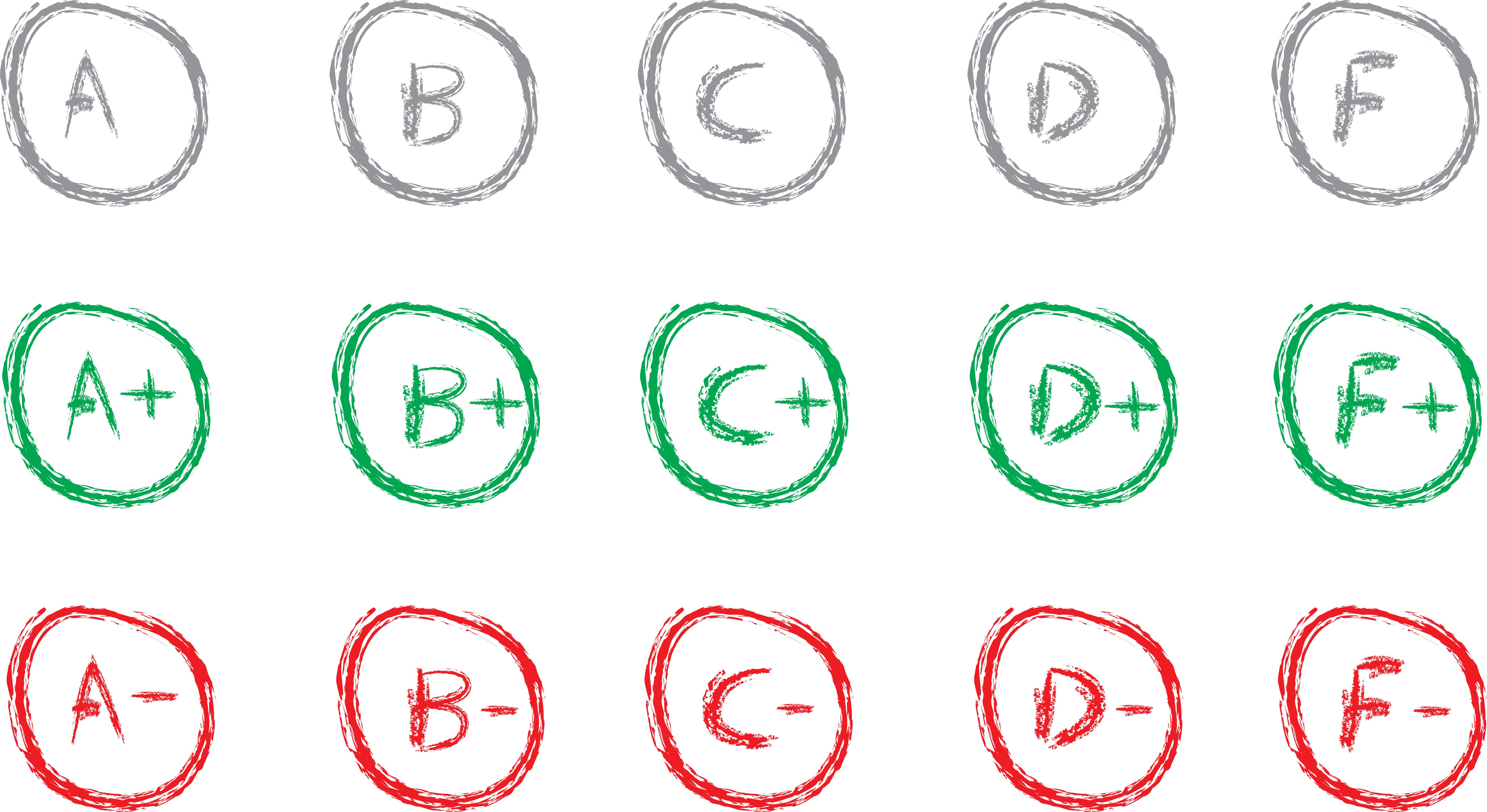
The new SBA Scorecard—covering the 2025 fiscal year—is full of bad news for small businesses: fewer dollars and fewer contractors across almost all categories. SBA gave the Federal government an ‘A’ grade anyway. But there’s a story behind that ‘A’ that might make you suspicious about whether the grade was deserved.
Here’s the worst of it: The Scorecard reported that the Federal government missed the 5% women-owned small business goal, reaching just 4.52%. That was the lowest women-owned spending in 12 years. The government also missed the 3% goal for HUBZone spending, at 2.66%, the lowest since 2022.
Two of the goals that the government achieved—23% for small businesses and 5% for service-disabled veteran-owned businesses—come with some big caveats.
Then there’s the 5% goal for small disadvantaged businesses. In its press release, SBA sounds disappointed that it met that goal at all. The release observes that “[a]lthough the federal government still exceeded its overall Small Disadvantaged Business contracting goal,” the disadvantaged spending had the “first decrease in 10 years.” The press release emphasizes the largest decrease in 8(a) contracting in 10 years. This resulted from efforts to “eliminate discriminatory DEI contracting practices,” SBA wrote in the press release.
It seems odd to applaud fewer dollars reaching small businesses, even a segment of them. But there wasn’t much else to celebrate. In fact, if you look at the number of new contracts awarded—a figure that isn’t on the Scorecard—the data looks even worse:
Instead, the Scorecard tracks the number of contractors on prime awards. The number of small business prime contractors dropped by over 4,000 to just 56,725. Just 13 years ago, that number was over 100,000. There are now fewer than 12,000 women-owned prime contractors, and just 2,619 HUBZone prime contractors.
The only increase was in the count of service-disabled veteran-owned businesses. The number of SDVO primes ticked up to 5,870. But, unfortunately for them, the larger number of SDVO firms were sharing a smaller amount of contract dollars. Spending with SDVO firms went down from $32.8 billion in 2024 to $32.5 billion last year.
And even that number is suspect.
Service-disabled veteran-owned spending is far less
The law now requires all service-disabled veteran-owned firms to be certified by SBA, and there are over 35,000 businesses that are certified. But, when SBA calculated the scorecard, it didn’t use the SBA certification.
The specific law in question is section 864 of the National Defense Authorization Act of 2024. The NDAA told SBA to count only SBA-certified service-disabled veteran-owned firms toward the Scorecard’s prime contracting goals. The law went into effect on October 1, 2024.
I don’t blame SBA for not following the law, though. It’s a SAM.gov issue. The problem for SBA is that—as certified veteran-owned firms already know—SAM.gov is woefully behind in reflecting SBA certifications. The veterans’ certification has been around for over three years. But it doesn’t show up in SAM.gov.
Instead, SAM.gov shows the old self-certification for veteran ownership—basically an unverified checkbox. That SAM.gov checkbox is what SBA used for the Scorecard (you can tell by comparing the Scorecard numbers to what is on SAM.gov).
And because SBA uses the checkbox instead of the SBA’s own certification, it overstated spending with service-disabled veteran-owned businesses by—according to my calculations—$6 billion. I found $6 billion in FY25 contracts that the Scorecard counted as going to service-disabled veteran-owned firms but went to firms that aren’t on the SBA’s certification list (other than joint ventures).1
So the actual spending with service-disabled veteran-owned businesses should be $6 billion less: just $26.5 billion. That also means SBA’s call that the government met the 5% goal for service-disabled veterans is off. If you throw out that $6 billion to non-certified firms—and that’s what the NDAA said to do—the government did not actually reach the 5% goal for service-disabled veteran-owned firms.2 They got to 4%.
That ‘A’ grade comes from extra credit
Here’s the story behind the ‘A’ grade: It’s the result of the teacher giving out extra credit in the middle of the exam.
If you look closely at the scorecard, the government got a 20 out of 10 grade for contracting with small disadvantaged businesses. That’s literally extra credit.
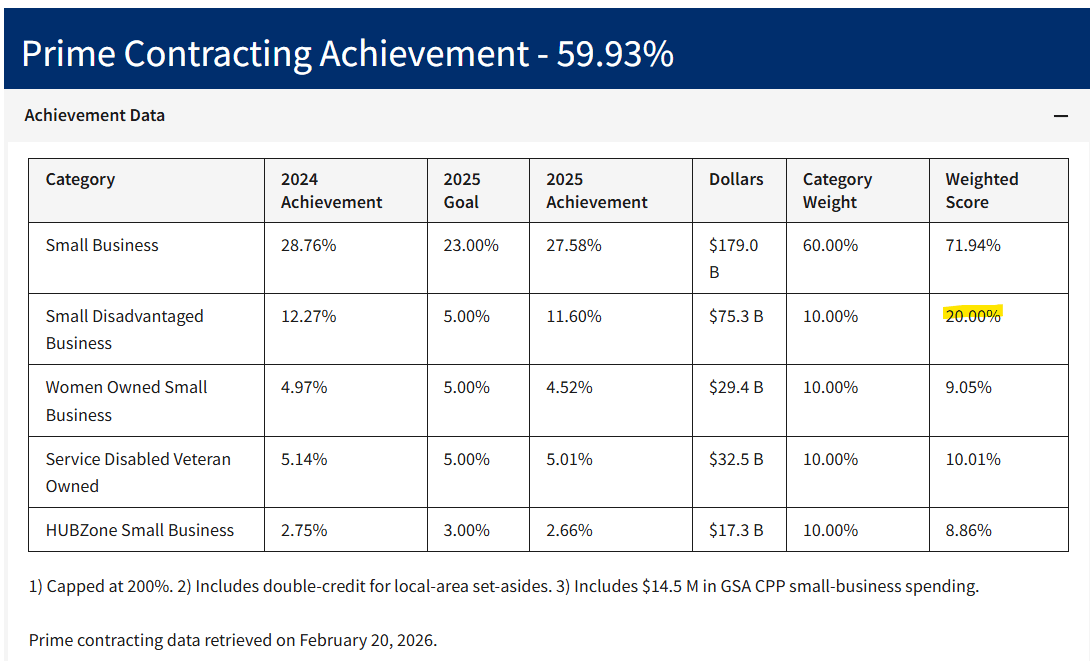
The reason the score is so high is that, at the beginning of FY25, SBA told agencies that they were going to push for a 15% disadvantaged business goal. That was a Biden Administration initiative, and the Trump Administration stopped it. So SBA dropped the goal in January 2025 from 15% to 5%. That was in the second quarter of the fiscal year.
That mid-year move was consistent with the Congressionally delegated authority to the White House to set governmentwide goals. But the problem is that SBA then gave agencies extra credit for exceeding the disadvantaged goal. Agencies more than doubled the goal, reaching 11% against a 5% goal. SBA allowed up to 2x double credit. That explains why the government got a 20 out of 10.
In the press release, SBA celebrates that disadvantaged spending in general—and 8(a) spending in particular—ended a 10-year stretch of increases. But SBA still gave agencies and the government 10 points of extra credit for spending as much as they did with disadvantaged businesses. The availability of extra credit on the disadvantaged goal lets agencies off the hook for missing the women-owned and HUBZone goals, since extra-credit points compensate for points missed on those goals.
Without the extra credit, the government would have received an overall score of 99.72%. In SBA’s grading scale, that’s a ‘B.’
How the 23% was calculated
The 23% goal has a different issue. SBA reported that agencies spent $179 billion, or 27.5% of prime contracts, with small businesses. (The press release combines prime contracts and subcontracts to report a $273 billion figure, but that’s not a number that appears on the Scorecard itself.) The $179 billion combines awards with different types of small businesses.
In another section of the Scorecard, SBA separates out the substantial 8(a) spending with Alaska Native, Native Hawaiian, and Indian Tribe-owned firms, from the lower spending with other 8(a) firms. Text above the graphs showing the disparity reads, “Tribal entity-owned firms are 16% of participants—yet receive nearly 70% of 8(a) dollars.” The text and graphs weren’t in prior Scorecards, so SBA is clearly trying to make a point.
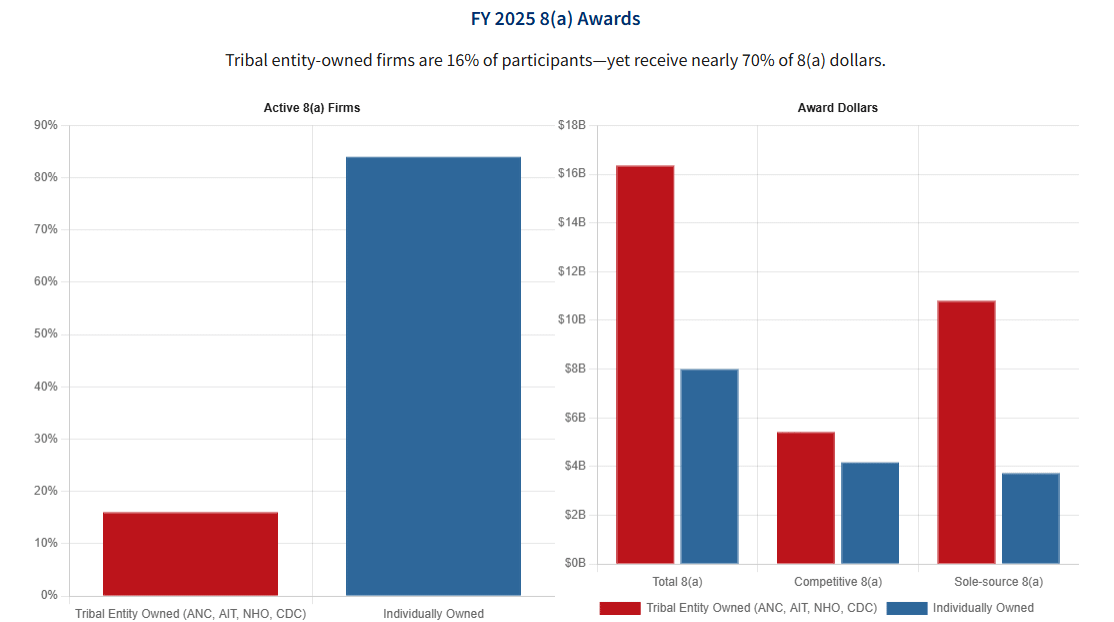
I’ll follow SBA’s lead and split that $179 billion into spending with Alaska Native/Native Hawaiian/Tribal firms, and spending with other firms. We can’t be sure what point SBA was making with that statement, but it’s intriguing enough to keep exploring. I’ll also separate out the Department of Energy subcontract spending that SBA counts as prime contracts.
The Native-entity firms won $27 billion in small-business contracts. The Department of Energy subcontracts added $8 billion. So non-Native small businesses received only $144 billion in prime contracts. That’s only 22% of all contracts.
I’m not saying this means the government didn’t meet the 23% goal. The history of the 23% goal shows that it counts Native-entity contracting. Congress actually increased the goal from 20% to 23% after the changes that let Native-entity firms qualify for SBA programs. I don’t think anyone expected they would eventually win $27 billion in small-business contracts, though. That amount is more than spending with HUBZone firms, 8(a) firms, or certified service-disabled veteran-owned firms. It’s almost as much as was spent with women-owned businesses, and might surpass that program in a year or two.
So, in a Scorecard with mostly bad news, there’s a positive note for Native-entity firms. They continue to see their contracting dollars rise.
With 20 years of Federal legal experience, Sam Le counsels small businesses through government contracting matters, including bid protests, contract compliance, small business certifications, and procurement disputes. His website is www.samlelaw.com. This article is for informational purposes only and does not constitute legal advice.
Ethan Nguyen contributed to the data gathering for this article.
There’s a pesky nuance that I didn’t account for in doing these calculations. You really should be checking the company’s certification as of the date that it won the award. But I don’t have historical certification records. Instead, I counted a firm as certified if it is listed on the SBA list as being active or previously certified. If anything, that overstates the spending with certified firms because some firms might have gotten certified after receiving an award, or lost their certification before receiving an award.
The $6 billion went to 1,440 unique self-certified firms that are not certified by SBA for the service-disabled veteran-owned small business program.
The tribal entity note is an interesting editorial choice to make while claiming with a straight face they aren’t a target of their attacks on the 8A program…..
Sam Le’s research on the shrinking number of small businesses with federal contracts matches what I have been seeing at individual agencies. The impact? Small firms in hundreds of counties shut out of the federal marketplace. This is a loss of competition that inevitably raises price and stifles innovation. Consolidation also shuts out local expertise that can’t be replicated. According to Sam Le, “The number of small business prime contractors dropped by over 4,000 to just 56,725. Just 13 years ago, that number was over 100,000. There are now fewer than 12,000 women-owned prime contractors, and just 2,619 HUBZone prime contractors.” More on our research in the comments…