

“The way to stop discrimination on the basis of race is to stop discriminating on the basis of race,” Chief Justice John Roberts famously wrote in a 2007 opinion, striking down a Seattle school district program for racial balancing. For a few years, that worked—programs actually stopped discriminating based on race. The Supreme Court invalidated college admissions programs, and SBA reformed the 8(a) program’s “social disadvantage” test in 2023. SBA was requiring all 8(a) applicants to submit individualized social-disadvantage narratives. But now, almost 20 years after the Chief Justice’s call, SBA wants to go back to discriminating based on race.
There is no other way to read the SBA’s proposed rule published last Friday.1 Titled “Reforms to Remove SBA’s 8(a) Program’s Rebuttable Presumption of Social Disadvantage for Individually Owned Firms Only,” the proposal would bring the 8(a) program back to discriminating based on race. SBA wrote that the way social disadvantage in the 8(a) program operated until 2023 “rendered white Americans almost totally unable to participate in the program.” Because of this inability, SBA proposes what it calls a “remedy.”
That “remedy,” the Agency writes, would address the prior “unconstitutional discrimination against members of groups who were not subject to the Rebuttable Presumption.” That rebuttable presumption refers to the pre-2023 rule that preferred five groups—Black, Hispanic, Asian, South Asian, and Native Americans—for admission to the 8(a) program.
Who are the groups not subject to the rebuttable presumption? Officially, it’s anybody who isn’t in those five racial categories. But, most obviously, it’s the white Americans that SBA says were “almost totally unable” to participate. The SBA press release claims that the 8(a) program was “crowding out legitimate job creators, especially white Americans.”
Senator Edward Markey, ranking member on the Senate Small Business Committee, issued his own release calling SBA’s proposal ahistorical. “The SBA’s proposed rule grossly diminishes the history of systemic racial and ethnic discrimination in the United States,” Markey said.
In SBA’s proposal, white Americans—and other groups not in the list of five—would be able to claim 8(a) eligibility as “socially disadvantaged.” (I mentioned Middle Eastern/North African in my podcast last week.) They would qualify because “prior iterations of [SBA regulations] … excluded the [applicant’s] racial or ethnic group as a group entitled to a rebuttable presumption of social disadvantage.” Under the new social-disadvantage test, they would be able to self-certify their membership in the excluded group and that they suffered individual harm.
So that’s SBA’s remedy. Because Black, Hispanic, Asian, South Asian, and Native Americans had a pre-2023 rule in their favor, the new rule would favor everyone who isn’t Black, Hispanic, Asian, South Asian, or Native American.
Race would still matter in SBA’s “remedy.” It’s just not the races that mattered before.
What SBA missed in its own data
What about SBA’s assumption that pre-2023 preference “rendered white Americans almost totally unable to participate in the program?” SBA needed only to check its own data to see that it’s not true.
Every year, SBA reports membership in the 8(a) program to Congress. The reports from 2009 to 2024 are up on SBA’s website. The oldest reports actually used to include numbers on the participation of “Caucasian Americans.” In 2009, that category accounted for over 7% of the 8,800 firms in the 8(a) program. It’s not a lot, but it’s also not “almost totally” zero.
Over time, Caucasian was wrapped into a general “Other American” category that represented anyone not in the five preferred groups. The latest SBA report showed that “Other Americans” owned over 5% of the 8(a) firms owned by individuals. Again, that’s not as close to zero as SBA’s “almost totally unable” statement suggests.
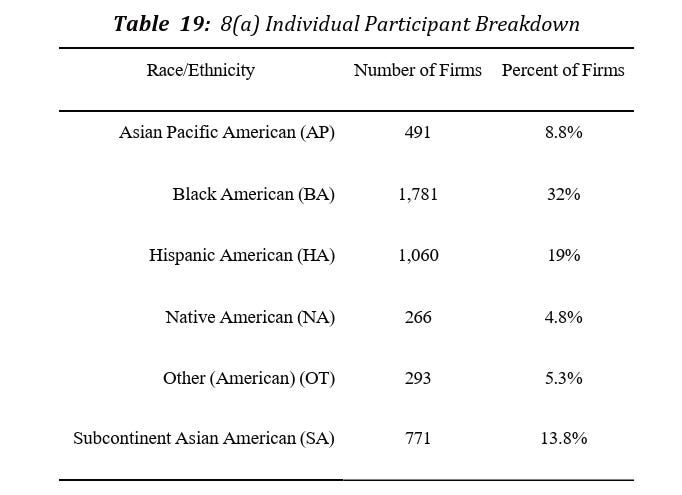
It’s true that these Caucasian and Other American figures are small in comparison; both are under 10%. But remember that those are a percentage of a small segment of government contracting. As Jackie Robinson-Burnette reminded me in our recent podcast, the 8(a) program is just a small part—about 3%—of government contracting overall.
“Other Americans” contracting looks much better when you look at contracting overall. SBA previously published race-disaggregated data that makes this analysis easier. But those figures have disappeared from SBA’s website. Fortunately, the Internet Archive has the old numbers, showing that “Other Small Business”—small businesses that don’t identify a minority group—received 16% of all government contracts in 2024.
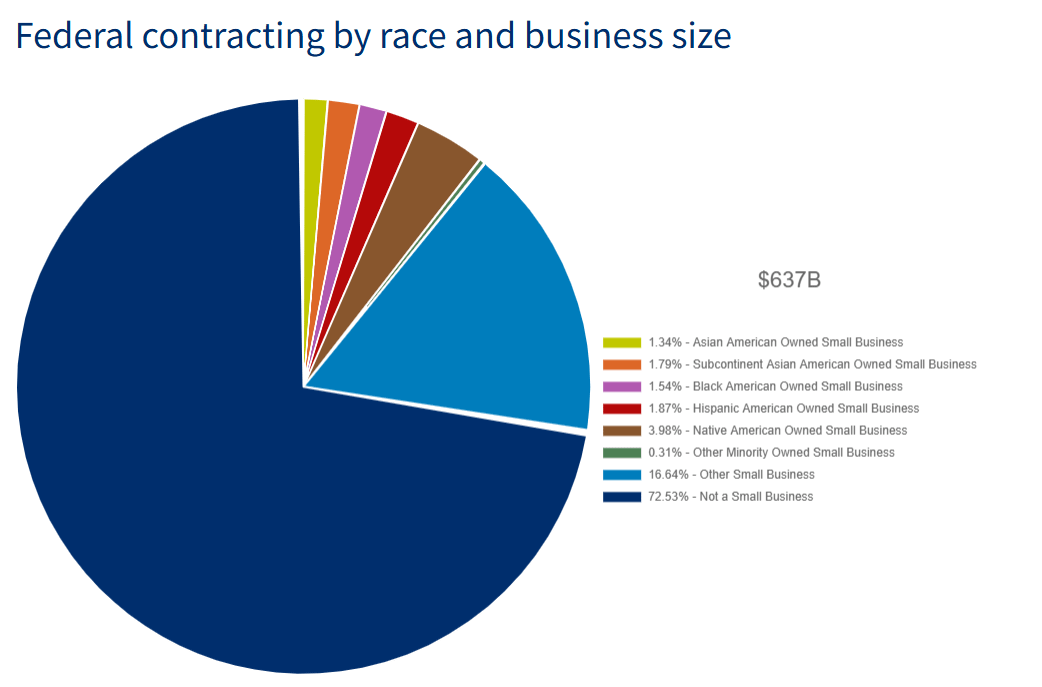
Those numbers represent all government contracts, though, including those to big Defense contractors. The more useful analysis is to see how much “Other” received out of set-aside contracts for small businesses. Small businesses owned by “Other” received over half of all set-asides last year. Much of the remaining half went to Native firms owned by Alaska Native Corporations, Native Hawaiian Organizations, and Indian Tribes.
According to this data, “Other” category businesses don’t need the 8(a) program to win contracts. That’s not the case for those businesses in the five racial groups, though. Each one of the five groups receives more than a quarter of its set-aside contracts through the 8(a) program. The Native American category receives the most—again, because of the substantial amount of contracts to ANCs, NHOs, and tribes.
If finalized, the SBA proposal will shift those figures substantially. Companies in the “Other” category—including those owned by white Americans—would qualify as “socially disadvantaged” and thereby receive more of their contracts from the 8(a) program. That would likely add to the $69 billion that those companies already get from set-aside contracting.
The 8(a) program’s intent
Aside from creating a “remedy” for the pre-2023 rebuttable presumption, SBA justified its proposed rule as “ensuring” “that the programs’ intended purposes are not subverted.” But the proposed rule doesn’t discuss what the 8(a) program’s “intended purposes” are. Those purposes are the opposite of what the agency is proposing.
The purpose of the 8(a) program is easy to find. There is literally a law, part of the Small Business Act, that says that “the purpose of section 8(a) [is] to”—and then proceeds to emphasize equality for socially and economically disadvantaged individuals: “promote the business development of small business owned and controlled by socially and economically disadvantaged individuals so that such concerns can compete on an equal basis in the American economy.”
The same law describes what Congress believed “socially disadvantaged” means. “[P]ersons are socially disadvantaged because of their identification as members of certain groups that have suffered the effects of discriminatory practices or similar invidious circumstances over which they have no control.” (15 U.S.C. 631(f)(1)(B).)
The law goes on to list that “such groups include, but are not limited to, Black Americans, Hispanic Americans, Native Americans, Indian tribes, Asian Pacific Americans, Native Hawaiian Organizations, and other minorities.”
The racial list is in the law itself, so I’m not sure what is “subverting” what here. SBA claims that its proposed rule “aligns with the statutory text,” including that purpose language above. But the proposed rule doesn’t actually have the purpose language. The proposal misses that Congress referred to “certain” groups. It misses that, in the law, social disadvantage comes from “discriminatory practices or similar invidious circumstances.” It misses the emphasis on equality.
This doesn’t mean that SBA’s proposal is necessarily wrong under the statute. But it means that the agency didn’t meaningfully grapple with the 8(a) program’s actual intent, despite suggesting that it had. That oversight is something to watch given the stricter Loper Bright standard for judicial review. Plus there’s the effect of the latest from the Supreme Court.
A “colorblind Constitution”
SBA’s biggest hurdle to finalizing its proposal might be its unintentionally poor timing. Nearly twenty years after Chief Justice Roberts’s call to “stop discriminating on the basis of race,” SBA might have thought that the pendulum had swung so far to the other side that its “remedy” could pass legal muster.
Not so fast. Just a week before SBA issued its proposed rule—presumably while SBA’s rule was in final review—the Supreme Court made a major pronouncement about race-based programs. The Supreme Court declared in a voting-rights case that the United States is bound by a “colorblind Constitution.”
This had been a long-awaited statement for the conservative legal community. The “colorblind Constitution” phrase derives from Justice John Marshall Harlan’s 1896 dissent in Plessy v. Ferguson, and it has gained steam recently as a rallying cry against race-conscious readings of the Reconstruction Amendments. The Pacific Legal Foundation, which I wrote about recently, echoed the phrase in an op-ed about the bill to kill the women-owned small business program—a bill that also eliminates the concept of social disadvantage.

“Colorblind” would seem to apply to all programs that favor some races, regardless of what they are. But SBA’s proposed rule refers to an applicant’s “racial or ethnic group” as a basis for social disadvantage if that group was “excluded…as a group entitled to a rebuttable presumption of social disadvantage.” The SBA proposed rule also says that an applicant can claim social disadvantage because a government or other entity “discriminated or was biased against a clearly defined racial, ethnic, or cultural group.” To qualify as socially disadvantaged, an applicant in one of those groups self-certifies their group membership and their individualized harm.
There could have been another way. As I wrote when it first came out, the Department of Transportation’s interim final rule on the Disadvantaged Business Enterprise program requires that disadvantage “must not be based in whole or in part on race or sex.” That would seem to allow other bases, like disability or religion.
And, in legislation being considered to reauthorize that DBE program, the Build America 250 Act would define disadvantage based on “the types of discrimination prohibited under Federal law.” That implicitly covers race, color, national origin, age, disability, and other criteria.
So SBA had other options. But it chose one that explicitly invokes race. The goal, as the agency proclaimed in its press release, is that no one is denied 8(a) admission “simply because they are white.”
Comments on the proposed rule are due July 13. Then it’s up to the SBA to decide whether, under a “colorblind Constitution,” it can finalize a rule that sees the world in black and white.
Correction: In my livestream last week, I talked about data indicating that the number of 8(a) firms was below 3,000. The SBA database seems to have been glitching the day I pulled that data. According to the database today, the number of active 8(a) firms currently sits at 3,326. That’s the lowest since the mass suspensions following SBA’s 8(a) data call.
With 20 years of Federal legal experience, Sam Le counsels small businesses through government contracting matters, including bid protests, contract compliance, small business certifications, and procurement disputes. His website is www.samlelaw.com.
This article is for informational purposes only and does not constitute legal advice.
The full title also includes the sentence “Reforms Do Not Impact Entity-Owned Firms.” SBA presumably added that so the agency does not need to hold tribal consultations before finalizing the rule.
Very insightful analysis. Thank you.