


SBA wants to tighten the limitations on subcontracting—the rules that dictate how much of a set-aside contract the small business needs to do itself. Firms are flouting the rules, SBA alleges, and one tribal 8(a) firm even subcontracted 96% of its work to McKinsey & Company.
Here’s the problem: The 96% never happened.
GovCon Intelligence analyzed the $8.8 million contract that SBA is using to justify stricter subcontracting limits. The 8(a) firm, Cherokee Nation Federal Consulting, appears in the USAspending.gov database as having subcontracted 96% of its work to McKinsey. But it’s a data-entry mistake. Cherokee Nation subcontracted 41% of one 8(a) contract and 49% of a larger one, but the company mistakenly entered the two subcontracts into the first entry.
Nevertheless, SBA told its Office of Inspector General that, by next April, the agency will propose to change the limitations on subcontracting.
According to SBA’s memo, by that April deadline, SBA will advance regulatory revisions to
- Set new subcontracting thresholds that closes pass-through loopholes and ensures small businesses perform small business contracts;
- Clarify oversight, reporting, and tracking of limitations on subcontracting;
- Guide agencies on tracking and reporting of limitations on subcontracting;
- Develop collection mechanisms for SBA to better effectively utilize limitations on subcontracting reporting to root out waste, fraud and abuse; [and]
- Include any additional necessary changes to remove unambiguous language and ensure consistent interpretation, application, and enforceability of the limitations on subcontracts.
Even though the data-entry error was on an 8(a) contract, the SBA rule change would apply more broadly. The proposal would extend to all set-asides, including small-business set-asides and service-disabled veteran set-asides. SBA stated that the current limitations on subcontracting are so high that “small businesses fail to gain the past performance work and growth intended by small business set-aside contracts.”
And, even though the Cherokee Nation contract was for consulting, it’s actually construction firms that should worry the most. For services, the limitations are set by statute at 50%. For supplies, the nonmanufacturer rule applies. But, in construction, SBA can set its own standards. SBA’s memo suggested that the current self-performance standard of 15% in construction “allow[s] for wasteful and abusive pass-through contracts.”
SBA seems poised to raise that 15%. That means it’s construction firms that should act quickly to tell SBA what the change would do to their business.
Searching for fraud
The 96% subcontract incident follows a year-long hunt for fraud in SBA’s 8(a) program. SBA first alleged $550 million worth of fraud on a USAID contract. I found that it was actually $22,000 worth. Nevertheless, citing the much larger figure, SBA required all 8(a) firms to submit three years’ worth of detailed financial and contracting documents in what SBA called a “data call.” Over 3,000 companies submitted their documents to then-General Counsel Wendell Davis. (He’s now been replaced in that position.)
Nearly a thousand 8(a) companies did not respond, however. SBA terminated most of those firms from the program. In Matter of MSP Superior Services, OHA upheld one of those terminations.
Despite collecting all those documents, nine months later, SBA hasn’t announced finding any fraud from the data call.
That’s not to say that there isn’t fraud. A woman named Rebecca Davis recently pleaded guilty to defrauding the 8(a) program by applying under other names, Rebecca Numer and Rebecca Elstner. This evaded the program’s “one-time eligibility” rule and gave her multiple terms as an 8(a) owner.
That aside, what SBA really wants to find is pass-through fraud. It’s joined in that quest by the Claremont Institute, which hypothesizes that “[p]ass-through contracting [is] a persistent defect of the 8(a) program.”
The Claremont Institute—which has no association with the Claremont colleges—isn’t ordinarily a source of government-contracting scholarship. It mostly discusses citizenship and immigration. Many people know of it as the site of Vice President J.D. Vance’s speech about “Heritage Americans”: the one where he said, “I think the people whose ancestors fought in the Civil War have a hell of a lot more claim over America than the people who say they don’t belong.”
And, despite the claims of pass-throughs being a “persistent defect,” the Claremont Institute’s report on the 8(a) program doesn’t actually identify any fraud. It highlights a few contracts for Biden-era DEI programs, but those weren’t limited to 8(a). They find some 8(a) supply contracts that exceed 50% subcontracting. But that’s an inherent feature of the nonmanufacturer rule, which the Claremont Institute doesn’t acknowledge. I wrote about the complicated nonmanufacturer rule a while ago:

So the Claremont Institute didn’t find any noncompliance in the 8(a) program. Instead, it concluded that the program is “a form of corporate welfare.” Granted, if you use a wide definition, all small-business programs are “corporate welfare.” The corporate-welfare argument would be a good reason to oppose SBA’s proposed size-standards increases. They would extend the small-business programs to 114,541 more corporations, all of which are currently large under SBA’s definitions. But corporate welfare isn’t not enough to argue, as SBA has, that the 8(a) program is a source of “rampant abuse and fraud.”
Then SBA thought it found a 96% subcontract.
The 96% data-entry mistake
It’s worth noting that the source of the alleged 96% subcontract is a tribal 8(a) company, not the minority-owned firms that the Claremont Institute focuses on. Citizens of Cherokee Nation would seem to meet any possible definition of “Heritage American.”
SBA is invoking 96% to find common cause with the OIG for tightening subcontracting rules. But the Cherokee Nation company never reported 96% itself. That’s a calculation that SBA found at USAspending.gov—a calculation, it turns out, based on faulty inputs.
Cherokee Nation, like every contractor with a noncommercial contract worth $40,000 or more, must report its first-tier subcontracts into the former FSRS, now housed in SAM.gov. For each one, it enters the subcontract’s amount, date, recipient, and the associated prime contract.
The Cherokee Nation company entered its subcontract information incorrectly into FSRS. It has two 8(a) contracts with the IRS. The one with IRS Wage & Investment Division is for a data upload tool. The other, with the IRS Commissioner, is for improving executive governance. But, when the Cherokee Nation company entered its subcontracts for those two separate contracts (both were to McKinsey), it mistakenly associated those entries with the same IRS contract.
That’s how the Cherokee Nation company ended up with a subcontract for executive governance linked to a prime contract for data upload. It’s also how the data-upload contract appears as having 96% subcontracted. USAspending.gov displays a percentage subcontracted based on the total value of subcontracts associated with a prime contract:
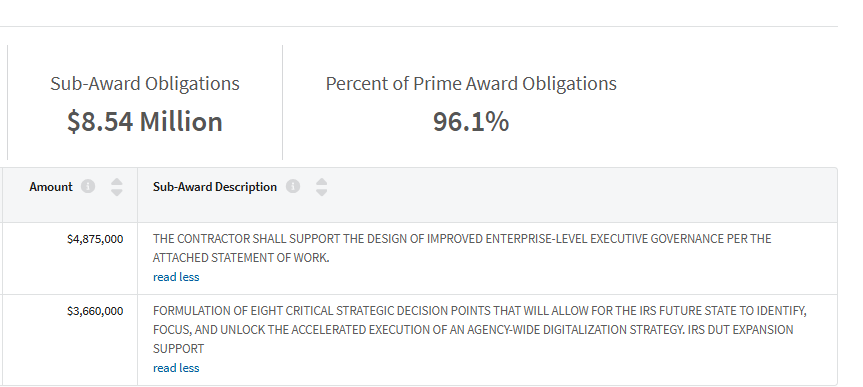
It’s not clear to me why USAspending calculates a percentage. Doing so allows a reader to make a value judgment about the subcontracting, based on incomplete information. That’s what SBA did. SBA pointed to the 96% to show that the current subcontracting rule “does not provide for the best interest of small businesses and limits SBA’s ability to oversee compliance to regulatory requirements.”
But there’s another rule that would solve these problems. And it’s currently on the books. Part of the Small Business Act, 15 USC 645, requires that the subcontract reporting system—now SAM.gov—notify SBA, the OSDBU, and the contracting officer if a small business exceeds the limitations on subcontracting. The Act states:
Not later than 1 year after January 2, 2013, the Administrator shall take such actions as are necessary to ensure that an existing Federal subcontracting reporting system is modified to notify the Administrator, the appropriate Director of the Office of Small and Disadvantaged Business Utilization, and the appropriate contracting officer if a requirement [of the Limitations on Subcontracting] is violated.
Look at that date again. The law says that this limitations-on-subcontracting tracking system must be in place within a year of January 2013. That’s just before the Baltimore Ravens won the Super Bowl in Ray Lewis’s last year. Barack Obama started his second term. The top album of that year was by Justin Timberlake. Now 13 years later, that system isn’t in place.
Construction companies, pay attention
Rather than enforce the current law, though, SBA wants to tighten the subcontracting limits. There’s only one industry where SBA can easily do that. The Small Business Act already sets a 50% limit in services. And it provides for the nonmanufacturer rule for supplies—which probably covers most small-business supply contracts—and a 50% limit where the small business actually manufactures the product itself.
After services and supplies, the only industry that’s left is construction. Congress gave SBA the authority to set the limitations on subcontracting “applicable to contracts for general and specialty construction.”
Currently, those limits are set at 85% for general construction and 75% for specialty trades. Just subtract from 100% to get the self-performance requirement: 15% for general construction and 25% for specialty trades.
SBA’s response to the OIG says 15% is too low. SBA wrote:
Current regulations on Limitations on Subcontracting allow for wasteful and abusive pass-through contracts, in part by requiring as little as 15 percent of a small business construction contract to be performed by small businesses. In other words, up to 85 percent of a small business contract does not have to be performed by a small business.
Because of the “wasteful and abusive” 15% self-performance rule, SBA will “[s]et new subcontracting thresholds.” It plans to advance those—presumably in a proposed rule in the Federal Register—within the next six months.
As we’ve seen with the 1,500% increases to size standards, SBA may want to do something big and unexpected. That could mean bumping up the 15% self-performance requirement for general contractors to something much larger.
The theory behind the 15% rule was always that general construction naturally involves a lot of subcontracting. No single company can construct an office building on its own, or military barracks for that matter. The limitations on subcontracting don’t apply to large businesses. So it didn’t make sense to impose a special rule on small businesses that didn’t reflect actual practice.
Now that SBA wants to move away from the current 15% rule, construction companies should explain to SBA how that affects them. Not just in April 2027 after SBA publishes its proposal, but beforehand.
Otherwise, they could get stuck with something they don’t want—because of a 96% subcontract that never happened.
With over 20 years of Federal legal experience, Sam Le counsels small businesses through government contracting matters, including bid protests, contract compliance, small business certifications, and procurement disputes. His website is www.samlelaw.com. This article is for informational purposes only and does not constitute legal advice.
The upper management of the SBA has been corrupted. SBA Administrator Loeffler needs to be removed from her positions after the mid-term Congressional Elections have concluded. If SBA Management remains unchanged, the Small Business Administration (SBA) will soon become the Large Business Administration (LBA)>