

The number of 8(a) sole-source awards has cratered, according to the most recent federal contracting data. Halfway through the fiscal year, agencies have awarded just 591 new 8(a) sole sources.1 Two years ago, that figure was almost 50% higher—873. If you go back to 2018, agencies had issued over 900 sole-source 8(a) awards by midyear.
You might think that agencies instead are turning to service-disabled veteran-owned firms. That’s where SBA has been putting its resources. But that’s not the case. The number of SDVO set-asides is basically where it was in 2023 and 2024, before DOGE cuts at VA.
Instead, the shift is to small business set-asides. The data shows a 25% increase in the use of small business set-asides. These are the ordinary set-asides that don’t require an SBA certification. Businesses simply self-certify as small in SAM.gov when they register to do business with the Federal government. The 25% increase in small business set-asides is the largest jump in my data set, which goes back to 2011.
If this data holds up, it means government contracting is undergoing a big shift. For years, agencies have concentrated on awarding set-asides on SBA’s certification programs. The 8(a) program reached all-time highs in dollars awarded in each of the last four years. The SDVO program grew so much that Congress increased the government-wide goal from 3% to 5%. And the government still met that higher goal.
But this early data indicates that certifications are taking a back seat to small business set-asides. That’s now where the growth is.
Is this the end of 8(a) sole source?
This halfway data isn’t surprising. The 8(a) program is the target of SBA, which launched a program-wide comprehensive audit and hasn’t approved an 8(a) application since August 15, 2025. As of the last count, SBA has suspended—at one point or another—over 1,400 firms in the program. Hundreds of those have regained their 8(a) status, but 715 remain suspended.
SBA hasn’t told agencies to stop using 8(a) sole-source awards. But it didn’t need to. Senator Joni Ernst, as the chair of the Senate Small Business Committee, did it herself. She sent letters to 22 agencies, seeking their action to pause sole-source awards until 8(a) had undergone a full-scale audit.
Some agencies have cut back. The request was temporary, but it’s hard to see how sole-source 8(a) bounces back to prior levels. I don’t anticipate that SBA will announce a clear end of the audit; instead, the agency likely will shift to a longer-term skepticism of 8(a) participants. And sole-source as a contracting method is disfavored publicly, making it an easy target for bad press.
Here’s a list of agencies and how many new 8(a) sole-source contracts they have awarded through mid-year. Half are in the single digits:
At this point, if agencies really want to use sole source, other routes don’t attract as much scrutiny. These include OTAs, CSOs, and SBIR Phase III. Those sole-source methods weren’t as prominent when 8(a) sole-source was at a higher level 15 years ago.
Also, new policies are making it harder to use 8(a) sole-source. The FAR Overhaul directs contracting officers that they “must first try” to compete the requirement using 8(a) multiple-award contracts before using an 8(a) sole source. I don’t know what trying means there—do you actually have to hold a competition? Plus, the “must first try” conflicts with SBA’s existing rules, which require an SBA waiver to use 8(a) competitions below $5.5 million.
SBA might change that waiver rule in the upcoming, yet-to-be-published proposed rule on “Fraud, Waste, and Abuse.” At the very least—given the proposed rule’s title and SBA’s linkage of the program to “rampant abuse and fraud”—SBA will probably propose some policies to limit 8(a) sole sources. The agency already added a scorecard element on “providing competitive value to the taxpayer.” So moving away from sole sources—and toward that “competitive value”—is right up their alley. The agency can’t get rid of sole-sources entirely. But it can make them much more painful to award.
It seems the tide has turned against 8(a) sole source, despite very good arguments for it. So what takes its place?
The new winner: small business set-asides
Not 8(a) competitive. The number of 8(a) competitive awards is down over 30% from 2024. That’s not quite as much as sole source, but 8(a) competitions aren’t picking up the slack for the 8(a) program overall.
You might think that agencies would switch to service-disabled veteran-owned, but so far that doesn’t seem to be the case. DoW and VA might adjust in the second half to increase their veteran-owned awards. But at this point, SDVOSB awards are level with where they were in 2024. Similarly, women-owned and HUBZone awards haven’t changed much from historical norms.
The big winner looks to be small business set-asides. That is to say that everybody wins. You don’t need SBA approval or a certification to qualify for a small business set-aside. It’s a self-designation on SAM.gov. You still could be protested on your size status if you win. And if that’s the case, then you’d have to open up your books to SBA during the protest process, both for size—either in revenue or employees—as well as for issues of affiliation. But, unlike the other programs, small-business qualification doesn’t require a prior review by SBA.
Why are agencies increasing the use of small business set-asides? I heard a good theory from an IDIQ expert this week. Agencies are under pressure to consolidate their contracts, so they end up with fewer contracts overall. When they combine contracts, they could be consolidating contracts that were previously separately held by companies with different certifications. So you could be consolidating an 8(a) contract with a women-owned contract and a HUBZone contract. The way to allow all those incumbents to compete for the new contract is a consolidated small business set-aside.
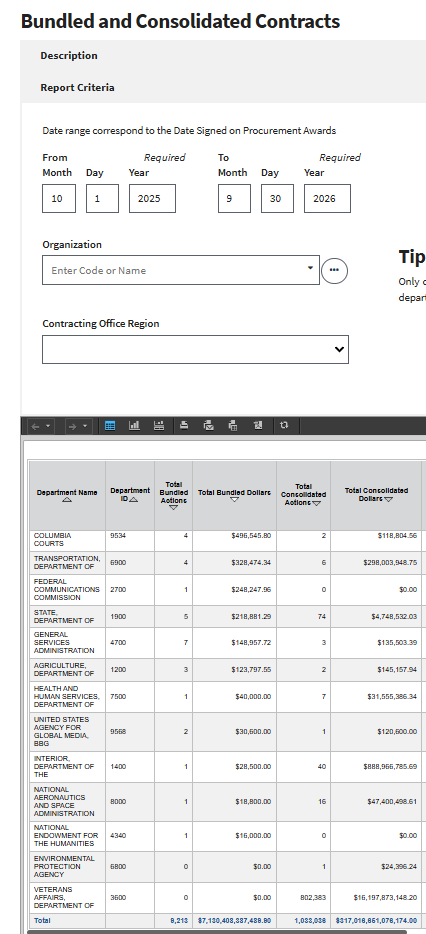
And, indeed, the level of consolidation is off the charts. SAM.gov shows consolidation increasing 100-fold in just this first half of FY26 alone.2
Why 8(a) is still valuable—for now
The steep decline in the use of the 8(a) program doesn’t mean that participants should head for the exits. There’s still value in the program. That’s because, although the pie might be shrinking, the number of pie eaters also is going down. After all those suspensions, there are now fewer than 3,500 active 8(a) firms. And there still will be about $20 billion going through the program this year. That’s mostly because there were a lot of 8(a) awards over the past years that will continue to receive obligations through 2026.
In fact, in comparing the 8(a) program to the service-disabled veteran-owned program, the 8(a) program doesn’t look all that bad. There are 35,000 certified SDVO firms, almost 10 times the number of 8(a) firms. But the number of SDVO awards at mid-year is only about 50% more than the total number of 8(a) awards. So that’s 10 times as many SDVO firms going after just 1.5 times the awards.
With those odds, I’d rather be 8(a). That’s not to say that the odds won’t change. Agencies might continue to shift away from sole source. Or SBA might tighten the screws on sole-source approvals through policy.
Regardless, the action is now in small business set-asides. That’s a much more competitive market. There are 60,000 small businesses that have Federal contracts. And over 400,000 small businesses are registered in SAM.gov. The bright side of that market is that eligibility comes with far fewer requirements. No annual reports to SBA, like in 8(a). And no reporting on employees’ residences, as in HUBZone. You still need to understand the risks of affiliation and have basic knowledge of how size standards work. But that was the case for the other programs too.
Is it time to focus more on small business set-asides and less on maintaining SBA certifications? The data suggests the tide is turning. In a future post, I’ll look more closely at what these new small business set-asides are for and where they’re coming from.
With 20 years of Federal legal experience, Sam Le counsels small businesses through government contracting matters, including bid protests, contract compliance, small business certifications, and procurement disputes. His website is www.samlelaw.com.
This article is for informational purposes only and does not constitute legal advice.
All the data in this article is based only on awards exceeding $250,000.
The FY26 number of $317 trillion is hard to believe. Global GDP is only $100 trillion, so this might be a data-entry issue. But nevertheless, here’s the proof—a screenshot from the SAM.gov Databank report.
Interesting. Have you examined the impact of this transition on Alaskan Native American businesses? What are the characteristics of the small business sole winners?
Another great article with data to back it up. Sam, you stand above the rest of us in your analysis and unique perspective. And...your IDIQ expert is right. Now with the "once an 8(a), always an 8(a)" thought process removed, take what went to individual socio-economic groups and make it SB set-aside. More opportunity BUT also a bigger competition pool (and more offers). Not always bad but can add to the timelines for award depending on how the solicitation is structured.