

Jessica Tillipman is the dean of GW Law’s procurement law program and the leading expert on the use of AI in government contracting. I caught up with her about the Supreme Court’s tariffs decision, the potential for AI-enabled corruption, and the future of lawyering. Along the way, we discussed SBA’s recent wave of suspensions and proposed terminations of 8(a) firms.
An auto-generated summary of the conversation follows.
In this episode of GovCon Intelligence, Jessica Tillipman, the associate dean for government procurement law studies at the George Washington University Law School, discusses how rapid federal adoption of artificial intelligence is reshaping oversight, competition and integrity in government contracting.
The conversation opens with breaking news about a Supreme Court decision striking down tariffs as a tax and turns to Tillipman’s forthcoming article, Buying Blind: Corruption Risk and the Erosion of Oversight in Federal AI Procurement, which argues that “risky buying equals risky deployment” when agencies pursue A.I. without sufficient training, infrastructure and governance. Sam links those concerns to the Small Business Administration’s February 11 wave of more than 150—closer to 230—letters suspending or proposing termination of 8(a) companies, describing basic errors and legal deficiencies that suggest automated screening without adequate human verification or due process.
Tillipman explains her “wedding cake” model of the A.I. tech stack—chips, data and cloud infrastructure at the base; foundation models as the “brain”; applications near the top; and human oversight above it, with security and governance layered throughout.
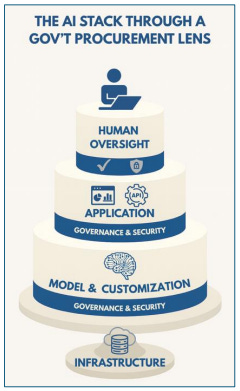
She warns that market concentration and preferred partnerships can deepen lock-in and complicate accountability. She also outlines how the stack can create organizational conflicts of interest, from biasing ground rules and unequal access to information to risks that arise during customization and fine-tuning, and she raises concerns about “algorithmic collusion” and the use of telemetry and logging data.
Drawing on South Africa’s “state capture” scandal, she describes how procurement can be exploited to capture institutions and argues that A.I., operating quietly inside data-rich agencies, could magnify those dangers.
The episode distinguishes between “corruption risks,” including A.I.-generated fraud, prompt injection and proposal gamification, and “integrity risks,” such as bias, drift, hallucinations, opacity and automation bias. Tillipman urges agencies to treat A.I. as an aid rather than a substitute, emphasizing human-in-the-loop oversight, traceability to solicitation requirements and proposal text, and the need to protect due process for those flagged by fraud tools. She critiques the current federal posture as governance in retreat—citing a speed-first approach, promotional OneGov pricing that can fuel behavioral dependency, and the disruption of a FAR overhaul alongside buyouts and retirements.
The discussion also addresses a ProPublica report on the Department of Transportation’s effort to draft regulations rapidly with Gemini and rumors of Pentagon pressure on Anthropic tied to contractual clauses allowing any lawful use of A.I. systems. Tillipman says these developments underscore that A.I. governance is not neutral and that the government still wields leverage, including through supply-chain risk designations.
Turning to the classroom, she describes growing anxiety among students about the job market and worries that heavy reliance on A.I. is eroding foundational legal skills, prompting a shift toward more in-person, closed-book assessment and instruction aimed at A.I. literacy. Tillipman predicts that industry may use governance as a competitive differentiator, but she expects a scandal-driven swing back toward reform.
She directs listeners to jessicatillipman.com and LinkedIn.
00:00 Meet Dean Jessica Tillipman (GW Law)
00:31 Small Business Affiliation Rules: The Paper That Shaped SBA Policy
02:23 Supreme Court Tariffs Ruling—What It Means for Business & GovCon
05:20 The paper, ‘Buying Blind,’ and AI Corruption Risk in Federal Procurement
06:16 SBA’s 8(a) Suspension Letters. Did AI Fraud Detection Get It Wrong?
08:48 ‘Risky Buying = Risky Deployment’: Human-in-the-Loop & Due Process Safeguards
11:36 The ‘Wedding Cake’ AI Tech Stack Explained
16:03 Conflicts of Interest in the AI Stack: Algorithmic Collusion, OCIs & Telemetry
21:40 South Africa’s ‘State Capture’ Scandal
25:47 Promo Pricing, OneGov Deals & Behavioral Dependency
30:23 Corruption Risk vs. Integrity Risk
32:31 AI Fraud & Voice Consent: The Next Wave of Scams
32:47 System Corruption in Procurement, Prompt Injection & Proposal Gaming
34:01 Hallucinations, Protests, and FAR Part 15: Why Humans Must Stay in the Loop
37:08 Using AI the Right Way in Evaluations
40:10 AI ‘Slop’ and Losing Your Voice
41:44 Speed vs Guardrails in the FAR Overhaul Era
45:35 Should AI Write Regulations? The DOT ‘20-Minute Draft Rule’ Debate
48:34 Prompts for Brutal, Bias-Checking Feedback
50:58 Pentagon vs Anthropic
54:48 Preparing the Next Generation for the Job Market
59:52 10-Year Outlook: Compliance as Advantage, the Next Scandal, and Finding the Middle Ground
01:02:54 Wrap-Up: Governance & AI Literacy as Differentiators + Where to Find Jessica Tillipman
About the Guest
Jessica Tillipman is the Associate Dean for Government Procurement Law Studies and Government Contracts Advisory Council Distinguished Professorial Lecturer in Government Contracts Law, Practice & Policy at the George Washington University Law School. She is a leading authority on public procurement, corruption, and the governance of AI in the public sector, with a particular focus on integrity, compliance, and emerging technology risks in government contracting.
With 20 years of Federal legal experience, Sam Le counsels small businesses through government contracting matters, including bid protests, contract compliance, small business certifications, and procurement disputes. Sam obtained his law degree from the University of Virginia and formerly served as SBA’s director of procurement policy. His website is www.samlelaw.com.
This video is for informational purposes only and does not constitute legal advice.


