

On today’s GovCon Intelligence live stream, I covered the current state of the 8(a) Business Development Program and the latest suspension numbers, significant OHA and Federal Court decisions, and SBA administrative changes. I also addressed the impact of the Washington District Office’s move to Herndon and previewed the OIG’s 2026 audit priorities.
Links and a full transcript follow.
Links
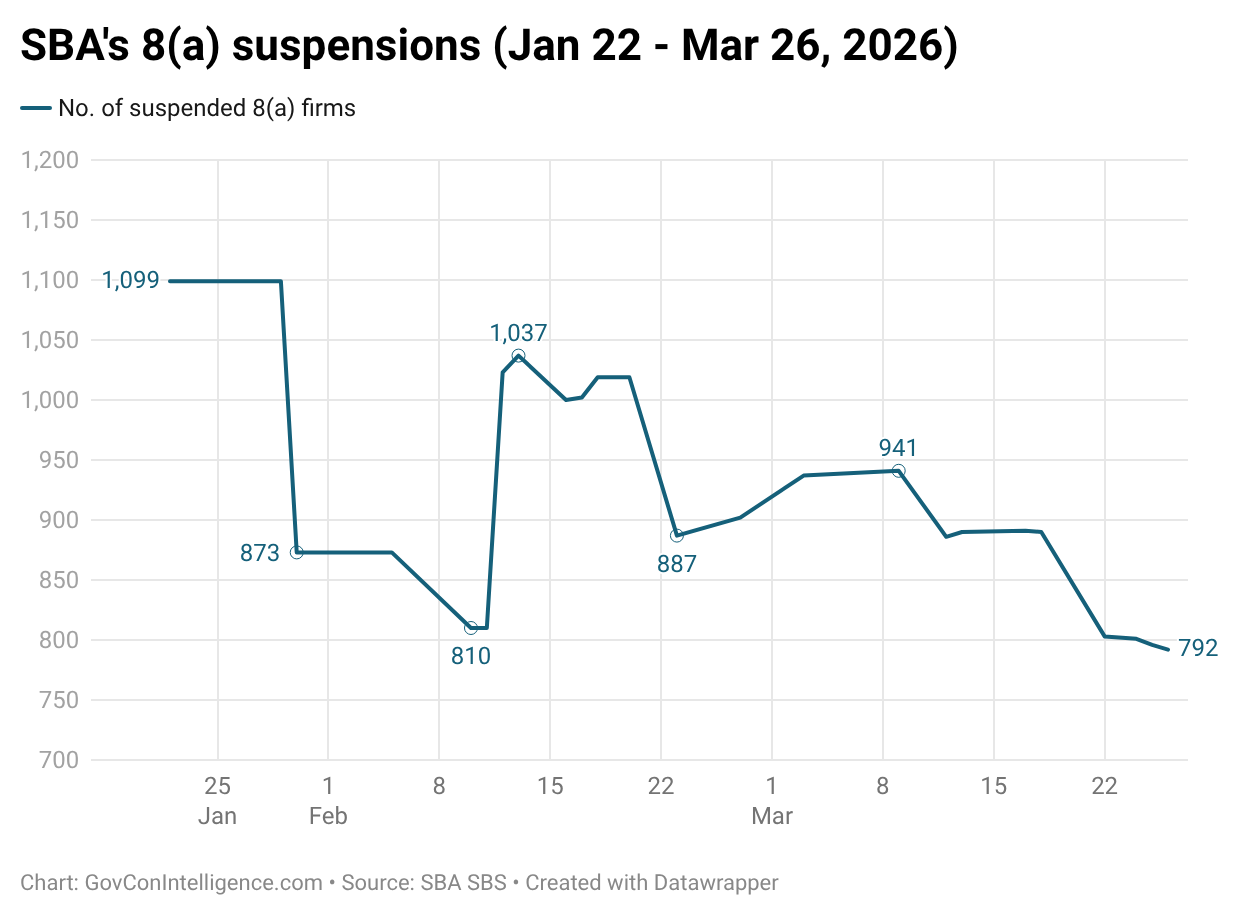
SBA’s 8(a) suspensions (Jan 22 - Mar 26, 2026)
Matter of ACC International Inc (OHA)
ThreatTec v. United States (Ct. of Fed. Cl.)
Stephen Bacon on the GAO’s decision in iAdeptive (LinkedIn)
VSBC Protest of Crosstown Courier Services (OHA)
News release: SBA Relocates Washington Metro Area District Office to Herndon, Virginia
Mid-America Milling Co. LLC v. US DOT (E.D. Ky.)
Ultima Services Docket (courtlistener)
SBA OIG Audit Division 2026 Oversight Plan
SBA OIG Evaluation of SBA’s All Small Mentor-Protege Program
New York Times: The Small Business Administration lent $378 billion to keep businesses afloat. Getting paid back is proving difficult.
Pending EO 12866 Regulatory Review on Fraud, Waste, and Abuse Reforms
EO 12866 Meeting on Fraud, Waste, and Abuse Reforms
Introduction & 8(a) Suspensions Update
Welcome to a GovCon Intelligence live stream. I’m live on Substack, so if anybody has the app, you can put comments into the chat, and I can answer any questions that you have.
I’m going to go through an update on 8(a) suspensions. There’s been a lot going on there. I’ll talk a bit about new cases that have come out. There was a major case about disadvantaged status that came out from a federal court. And then we’ll look at some developments within SBA, SBA news, actions by the Inspector General, as well as some progress on that proposed rule that I’ve been tracking.
So first, on 8(a) suspensions, I was running through the numbers today. Altogether, SBA has suspended over 1,300 businesses over the course of time in 2026. It looks to be almost 1,400, actually. Of those almost 1,400 businesses, 500 of them have gotten back into the program. Specifically, 498 have gotten back into the program. Ninety-seven are now listed as previously certified, so likely that means they withdrew or they have graduated from the program. And then 792 8(a) firms remain suspended. It just dipped down under 800 just a couple of days ago.
The pattern, it seems, is that SBA is pushing a lot of these changes in status on Fridays. The last couple of Fridays, there’s been a big chunk of firms that have either shown up as withdrawn or previously certified, and then another chunk that gets their suspensions lifted.
Now, I’ve had the experience of looking at this list every day and reaching out to firms and saying, “Oh, congratulations on getting off the suspension list”. And I’ve had the experience of the firms coming back and saying, “Oh, I didn’t know I was taken off the suspension list. You’re the first person to have told me this”. So evidently, when SBA lifts the 8(a) suspension—there are still 792 of them—SBA does not necessarily alert the firm that they’re now unsuspended. It just shows up on the SBA search website. You look for that firm one day, and they show up as suspended. The next day, they’re not suspended anymore.
So if you’re one of those 792 firms that is still suspended, I would recommend checking the SBA search website (search.certifications.sba.gov) every day, just in case your status changes. It looks like just today there were four firms taken off the suspension list. Three of them are now listed as previously certified, so likely that means they withdrew from the program. When these almost 1,400 firms altogether received their packages, they had the opportunity to withdraw from the program, and a number have done that.
So we still have 792 firms out there. Five hundred have gotten back. Maybe about 300 to 400 of those were in the first wave where SBA suspended firms for not replying to the data call. So there are maybe about 100 firms that have gone through the full reply process where SBA suspended firms for suspicion that they weren’t economically disadvantaged. The firms responded to that, and now SBA has lifted those suspensions.
All in all, if you look at these numbers, over a third of the firms that have been suspended at some point in 2026 are now back in the program. So there may be this suspicion that firms have done something wrong or that they’re somehow ineligible, but in a third of these cases, SBA has put the firms back in the program.
What that indicates to me, first of all, is that there were a lot of firms that didn’t reply to the data call, and a lot of those firms are back in because they’ve submitted their information. And then there’s also a large group of firms that were misidentified as being ineligible for other reasons, most likely economic disadvantage. SBA has now gone through, it appears, the responses of those firms to the suspicion of not being economically disadvantaged and allowed the compliant firms back into the program.
Just because you see a firm is suspended doesn’t mean they’re actually noncompliant or that they’ve actually done something wrong. Very likely, they’re going through a more manual review process from SBA, whereas before, it appears to have been computer-generated. The graphs tracking these firms are on GovCon Intelligence in the notes section, updated every few days. I try to take a look at the list every day so I can break the good news to people who have been unsuspended.
SBA Terminations and the Data Call
SBA did publish earlier this month that it has now moved to terminate 628 firms specifically for not replying to the data call. There may have been a lot of reasons for firms not to reply to the data call. There are a number of firms that have not even gotten 8(a) contracts. Over half of those firms did not get 8(a) contracts, and it was expensive to get all the documentation together. So they may not have seen the return on investment in replying to the data call and staying in the program.
There’s a suggestion in the press release that these firms have something to hide. Maybe there are cases where a firm has something to hide. I don’t think that’s true for 628 cases. I think a lot of these firms were not getting the value they expected out of the 8(a) program, or they’re seeing the pressure and scrutiny on the 8(a) program and think it’s no longer worthwhile for them to continue. It’s just a matter of, look, it’s a busy time of year. This data call came out around the holidays. You have proposals due, and it was just not something that was at the top of their priority list.
So I think it’s a bit disingenuous for an agency that should understand how small businesses operate—that they get busy, that compliance with these data calls is not necessarily at the top of their list when they’re trying to get proposals done, manage their employees, and find work—to say, “Oh, they must be hiding something”. I don’t think that’s the case for the vast majority of these businesses.
Office of Hearings and Appeals (OHA) Update
The suspensions, now numbering nearly 1,400, allow the firms to appeal to SBA’s Office of Hearings and Appeals (OHA). And OHA has been busy over the last few days. Just the other day, OHA published a large group of cases—27 cases that were decided on March 19th. That’s probably a one-day record for OHA officials publishing cases, 27 at a time. And then there are maybe about 10 cases that came out on March 18th, and a smattering of cases in the days before that.
All of these cases are dismissals. They’re all cases where a firm was suspended, appealed that suspension to OHA, and then OHA found—likely through SBA telling them—that the firm was no longer suspended. Sometimes the firm tells OHA, but more likely it’s SBA. And so OHA dismisses the case because it has become moot. There’s no additional relief that OHA can grant to a firm appealing a suspension if they are no longer suspended. So when we look at these 27 plus 10 plus a smattering of cases, all of those cases are dismissals of OHA suspension appeals.
There’s an important deadline that comes up on Monday for companies to appeal their suspension from that second wave, which was enacted on February 11th. You have 45 days to appeal a suspension. Forty-five days, I think, falls over the weekend, and under OHA rules, you get until the next Monday to file your appeal. So there’s a deadline on Monday for a lot of those firms that had been suspended in the February 11th and 12th timeframe to submit their appeals to OHA.
It looks like the appeals are being heard not necessarily by the longtime SBA judge, Christopher Holleman, but by a number of other judges who have been leased by SBA from other agencies. There’s one named Brian Haring; I wrote about him a few weeks ago. And then there’s another one named James Plott that appears on a number of these cases. Judge Holleman is still doing a number of the cases, but as these dozens and dozens—maybe even hundreds—of appeals come in, OHA has leased judges through an interagency agreement with another agency, such as HHS. It appears at least one of these judges is from CMS.
Understanding Economic Disadvantage: The ACC International Case
Speaking of OHA cases, there was a substantive decision that came out on this very issue of 8(a) eligibility earlier this month. It’s called the Matter of ACC International Incorporated, and it came out on March 9th. This is a really good case for companies that have economic disadvantage issues to read. Economic disadvantage is coming up in a lot of these letters of intent to terminate and these suspensions. Even companies that are going in for their annual review need to be aware of the economic disadvantage criteria for SBA.
Just to backtrack a bit, to be in the 8(a) program, as well as in the EDWOSB program, you need to be economically disadvantaged. There are three objective criteria for economic disadvantage. I think at one point SBA used percentiles, but they don’t use percentiles anymore. Now it’s numbers. You have to be below $400,000 in three-year average income. You have to be below $850,000 in net worth. And you have to be below $6.5 million in total assets. So those are the three objective criteria that firms have to comply with.
This ACC International case involved the income threshold, which is $400,000. SBA found that the individual in this case, Mr. Lopez, had a three-year average income of $493,475.50. So it was a very exact calculation by SBA. He was about $93,000 above the limit.
To address that, Mr. Lopez used an exception in the income rule at SBA. The income rule says that SBA will not consider income that the individual reinvested into the firm. Mr. Lopez was about $100,000 over the three-year average limit, so he reinvested $100,000 into the firm, trying to bring down that average so that it gets below $400,000.
There are two interesting things about this case. One is that SBA accepted that process. These three years have come and gone a long time ago—in this case, it was 2021, 2022, and 2023. The cutoff point for this three-year average was 2023, and Mr. Lopez came in in 2025 to reinvest this $100,000. And SBA said, “We will accept that. We will allow you to reinvest this and reapply the calculation of your income”. So that’s the first interesting thing, that SBA accepted that and recalculated the income.
The second interesting thing is that SBA recalculated the income to be $460,000. How do you get to $460,000? This is my absolute favorite thing, which is the combination of simple math and law. The reason you get from $493,000 to $460,000 is because it’s a three-year average. So if Mr. Lopez reinvests $100,000, he doesn’t get $100,000 off of a three-year average. He gets about $33,000 off of a three-year average because you have to divide it by three. So his three-year average goes from $493,000 to $460,000.
This case might have turned out differently if he had reinvested $300,000, where you bring down that average by $300,000 divided by three, which is $100,000. Maybe then he gets below $400,000, SBA recalculates it to be $390,000-something, and he wins the case. So it involves really interesting circumstances, and potentially, there could have been a way for this individual who was identified as not economically disadvantaged to get out of that situation by reinvesting money into the firm. That’s the ACC International case.
SBIR Phase III Bridge Contracts and the ThreatTec Case
Moving on with some relevant cases that have come out recently, there is a good case out of the Court of Federal Claims in a decision called ThreatTec about the SBIR program, specifically SBIR Phase III. This was a case where the agency (the Army) awarded an SBIR Phase III bridge contract to a company called Chitra Productions. ThreatTec protested that bridge contract at GAO. At GAO, there is usually a stay while they decide the case, but the Army overrode that stay so that they could go ahead with the bridge contract.
Then ThreatTec protested to the Court of Federal Claims, and the Court of Federal Claims threw out the case. The reason the Court threw out the case is that it said ThreatTech did not show that it was eligible for an SBIR Phase III award. To be eligible for an SBIR Phase III award, you have to have had a Phase I or Phase II contract previously, and it has to derive from, extend, or complete the SBIR Phase I or Phase II contract. ThreatTec could not show that. Probably they had never had an SBIR contract before; the case isn’t clear.
ThreatTec argued that the Army could have used something other than SBIR Phase III. Nothing forces an agency to use SBIR Phase III. Maybe the Army could have gone out and used a competition or a socioeconomic set-aside. But the court came back and said that’s not the issue right now. The issue is whether you have standing under SBIR Phase III and under the Percipient.ai case, which is a very important case that came out from the Federal Circuit and potentially could have been heard by the Supreme Court (though the Supreme Court did not grant cert). You no longer have standing because you are not capable of winning the vehicle that the Army chose, which is SBIR Phase III.
So you see now the application of Percipient.ai. When the case first came out, my biggest worry was about the Rule of Two application on orders—the Tolliver issue, if you’re familiar with that. Maybe that’s off the table now because of the FAR overhaul. I always thought no one’s ever going to bring a Tolliver case again because of Percipient.ai, and maybe now because of the FAR overhaul, nobody really is going to try to bring a Rule of Two order case. But now you see another application of Percipient.ai, which is this ability for agencies to award bridge contracts through SBIR Phase III and have protesters be unable to challenge a stay at GAO. Now, it will be interesting to see what this GAO protest comes up with. I don’t have any information about the GAO protest, but at least the Army was able to go ahead with performance and override the GAO stay.
Mentor-Protégé Past Performance and the iAdaptive Technologies Case
Speaking of GAO, I really recommend everybody look at Steve Bacon’s summary of iAdeptive Technologies, the GAO case that came out about the Mentor-Protégé Program. The case makes the point that SBA issued new mentor-protégé rules in January 2025. They address this issue that had been litigated over and over: how much past performance is required from the protégé in a mentor-protégé joint venture.
This was the issue that sank some really big GWACs, and they had to go back to the drawing board to figure out how to balance the past performance from the mentor and past performance from the protégé. SBA came out in January 2025 to basically say the agency has discretion. You decide, agency, do you want to take past performance from the protégé or do you not? Nothing requires you to take past performance from the protégé. Also, you have to make sure that the protégé is not subject to the same criteria as a non-joint venture offeror. Protégés are in the program because they’re trying to get business development; they probably don’t have as much past performance. So you’re not allowed to put the protégé under the same level of scrutiny as a company that’s coming in outside of a joint venture.
Those were not the facts here. The agency was upheld, even though it was accused of not considering the protégé’s past performance. Under SBA’s regulation, that’s okay. SBA says you do not necessarily have to take into account the past performance of the protégé.
Now, agencies reasonably could say, “Hey, the protégé is going to do 40% of the work of the joint venture; maybe the protégé should have some past performance”. For example, if there are five past performance examples required, it would be reasonable to have 40% of those come from the protégé since they’re doing 40% of the work. So that would be two out of five examples. But take a look at iAdeptive and take a look at Bacon’s summary of it on LinkedIn, which I’ll link to.
Corporate Transactions and SDVOSB Status: The Crosstown Courier Service Case
Let’s see. There is also a good case that came out of OHA. It’s a series of cases about corporate transactions under the title of Crosstown Courier Service. They deal with a two-step ownership transfer transaction.
Essentially, the veteran initially had ownership. Then he transferred the ownership to the company—that was step one. And then the ownership went to a service-disabled veteran—that’s step two. At the beginning, you have a service-disabled veteran owning the firm. At the end, you have a service-disabled veteran owning it. But in the middle, the company owns it. It seems like there might have been some issues about getting paperwork signed, but it was a two-step transaction.
OHA said that at the end, the company is still eligible as an SDVOSB. There was a 12- or 13-day gap between those two steps, and the protester argued that the company was ineligible because of that gap. They argued it did not keep its SDVOSB status during the whole process. I think this was a VA case because the VA has that special rule now that you have to be in the database both at offer and at award.
Regardless, I think OHA was looking at this at the time of offer. At the time of offer, this firm had already gone through the two steps, so it was eligible under the SDVOSB criteria. It was important in the second case—the petition for reconsideration—that these two steps were linked. OHA said there was a clear intent for the firm to be owned by a service-disabled veteran at the end of the process, and you can see the steps leading to that outcome across the 13-day window. Because of that intent and the fact that the changes were really part of one big transaction, OHA said this firm still qualifies as an SDVOSB for the contract.
That’s a good practice tip for companies that are looking at mergers and acquisitions. If you don’t have that intent between the two stages, or if you have a gap much longer than 13 days, you may not be able to work under the criteria set in this case. But if you need to have multiple steps to your transaction for whatever reason, I think it is important to take a look at this Crosstown Courier Service decision to see how the parties were able to connect the dots to end up with the SBA certification at the end of the day. I’ll link to those as well.
SBA Office Relocation
Some news out of SBA headquarters: SBA announced this week that it is relocating its Washington metro area district office to Herndon, Virginia. Herndon is in Fairfax County, where I live, so I know a little bit about Herndon. I don’t go there all that often. Parking in D.C., where the Washington District Office is currently located, costs as much as $25. Because of that, the office in D.C. didn’t host as many in-office events as other district offices might have. Herndon is far from Washington, D.C.; it is where Dulles Airport is located. It is right outside of Dulles Airport, so you are talking about a 25 to 30-mile distance. You are also talking about paying tolls each way—I think $3 tolls each way—to get to Herndon and back.
The Washington, D.C. District Office is not just responsible for D.C. firms; it also handles Virginia firms. There may be some firms that are actually closer to this Herndon office, particularly those out in the tech corridor around Chantilly and Dulles Airport. However, there are also firms in Maryland, such as those in Montgomery County and Prince George’s County, for whom it is going to be much farther to get out to Herndon. I think there is a Metro stop a few miles away, or perhaps less than a mile away, where you then take a bus to the SBA office. But it is not the same as taking the Metro straight into the Washington, D.C. headquarters.
I think the significant effect of this change is not necessarily on the firms. Firms are probably going to be willing to drive if they need to have a meeting or an in-person event. There are already many in-person events held there because of the proximity to the airport. The bigger effect is going to be on the employees who work for the D.C. District Office. The D.C. District Office has the largest number of 8(a) firms that it services; it represents probably about 10% of the portfolio. We are talking about maybe 200 to 300 firms, perhaps a little more or less. It is a lot of firms—all the firms in D.C., Northern Virginia, and Metropolitan Maryland.
Maryland also has a Baltimore office, and Virginia has a Richmond office, so they split the workload between those two states. But D.C. has the largest number of firms and does not have a commensurate number of Business Opportunity Specialists (BOSs) to conduct annual reviews and provide servicing to that large number of firms. If you are moving the office almost 30 miles away, you are going to experience some employee attrition. There are likely employees who live in Maryland or far away from the new office, particularly those who do not want to pay that toll each way. You are going to lose some BOSs, and that will put even more pressure on the remaining BOSs to service hundreds of 8(a) firms within the metropolitan D.C. area.
Challenges in 8(a) Program Servicing and Application Approvals
We are already seeing a decline in the amount of service for 8(a) firms. We have seen that with the application numbers. I’ll say it again: I just checked today, and there has not been an application approved by the SBA in the 8(a) program since August 15th. On August 15th, the SBA approved the application of a firm out of Vienna, Virginia, and they have not approved one since.
You are already seeing a decline in service regarding applications, and I fear that because of this move, you will see a decline in service on the participation side. This affects firms getting their annual reviews completed and getting their contracts approved, because the BOSs have a role in approving new contracts coming in from agencies. That is the offer and acceptance process, as well as the process of approving the specific company that receives the contract. While this relocation may be a good thing for some firms who can drive out there for in-person events, I do think it will have a negative impact on the employees working there.
The Mid-America Milling Decision and DBE Program Presumptions
Speaking of the 8(a) program, a related decision recently came out regarding the DBE program. Remember, at one point we had cases proceeding regarding both the 8(a) and DBE programs and entity-owned participation. We now have the final decision in the DBE case, the Mid-America Milling case, which originated in the Eastern District of Kentucky.
The litigant, Mid-America Milling, challenged the Department of Transportation (DOT) Disadvantaged Business Enterprise (DBE) program for using race and gender-based presumptions. At the time, this was a significant matter because it was the first case to focus specifically on Women-Owned Small Businesses (WOSBs), as women-owned businesses were presumed to be disadvantaged in the DBE program. That was not the case in the 8(a) program, nor is it the case for the Small Disadvantaged Business (SDB) definition.
This firm sued the DOT in Kentucky, arguing that these presumptions violated the Constitution. About ten months later, the court granted a request for a preliminary injunction. It was a limited injunction, geographically restricted to not allow the use of the presumption in the states covered by the plaintiffs.
This recent decision moots the case, and the judge dismissed it as moot. The reason is that at the beginning of this fiscal year, October 1, 2025, the Department of Transportation administratively removed the presumption from the DBE program. The DOT issued an interim final rule stating that the presumption would no longer apply to the DBE program. Consequently, there is no longer a presumption based on race or gender. As a result, tens of thousands of DBE participants across the country were required to submit narratives to their state certifiers to determine whether they are disadvantaged under that state’s review for the DOT DBE program.
For the purposes of this case, the narrative is not as important as the administrative action to remove the presumption. There is no longer a presumption because of this decision from the DOT, not from a judge. The court dismissed the case because it stated this was essentially what Mid-America Milling wanted. The government has removed the presumption, and the court noted that even if the litigation continued, it could not grant the plaintiffs any additional relief beyond what they have already received via the regulatory change.
There were arguments regarding what might happen if a future administration changes it back or if the new interim final rule is challenged in court. The court’s response was that those issues are not currently before them. There is a good metaphor in the ruling: “To salvage jurisdiction under such speculative bases would be akin to declaring a yet unborn racehorse as the betting favorite to win the 2029 Kentucky Derby.” It is a great line coming from a court in Kentucky. Essentially, they are saying they cannot rule based on what a future administration might do. So, the bottom line is that Mid-America Milling is off the table. The interim final rule is the document that governs the presumption; it says no presumption in the DBE program, and as a result, DBE firms are submitting their narratives.
New Legal Challenges to Private Sector Diversity Programs
Additionally, these lawsuits are coming in “hot and heavy” regarding preference programs. There is now a lawsuit in Kansas against the National Minority Supplier Development Council. This was filed by the American Alliance for Equal Rights, led by Edward Blum, who also filed the Students for Fair Admissions case.
This lawsuit challenges a program that certifies companies for private contracting—not for government contracting, but for corporate supplier diversity programs. It was filed in the District of Kansas about two weeks ago. It alleges that the program violates the Civil Rights Act, 42 U.S.C. § 1981, by denying businesses the opportunity to contract on equal terms based solely on the race or ethnicity of their owners. I will keep an eye on that.
Updates on the Ultima Services Case and SBA Regulations
I also wanted to check on the Ultima Services case. Remember, Ultima Services is what struck down the SBA presumption back in 2023. It was released just a month after the Supreme Court issued its affirmative action case. Essentially, nothing has happened in the Ultima Services case since 2023. There have been a few filings, but there has been no final decision. I know people were waiting to see if a final decision was forthcoming, but literally nothing has happened since August 20, 2025. If you check PACER, that is the date of the last filing.
I do not know if the court is still going to issue a decision. They may look at the Mid-America Milling case and say this is moot because the SBA is not using the presumption. The interesting distinction there, however, is that the SBA has not actually removed the presumption from its regulations. It is not quite the same as what the DOT did. The DOT issued an interim final rule, whereas the SBA has only issued guidance and messages to firms and the workforce. The SBA has not yet removed the presumption from its regulations, but that could be happening soon.
Status of SBIR/STTR Program Reauthorization
I have also been tracking the progress of the SBIR legislation. SBIR has been suspended—at least Phase I and Phase II—since the start of the fiscal year because it is a limited-term program and the last term ended. There is a bill, S.3971, that has passed the Senate and the House. It passed the Senate on March 3rd and the House on March 17th.
However, it does not show as having been presented to the President yet. It seems to be taking a long time. I am not well-versed enough in the legislative process to know exactly when something is presented for signing. There is some thought that because the President said he would not sign anything until the Save America Act is enacted, he may not be open to signing this SBIR reauthorization. We could be waiting a long time to get SBIR back, even though it has already passed both chambers.
The SBA OIG 2026 Oversight Plan: Audit Priorities
Another item from the SBA: the Office of Inspector General (OIG) published its 2026 oversight plan. In the past few years, there have not been many government contracting audits from the SBA OIG, as they have been focusing on COVID-era loans, disaster assistance, and Economic Injury Disaster Loans (EIDL).
However, there is a significant amount of government contracting in this 2026 oversight plan. There will be an audit of the VetCert program. There is going to be an audit of entity-owned 8(a) firms, specifically regarding community benefits reporting. That is a new audit; I don’t believe they have looked at community benefits reporting before. There is also going to be an audit on the process for certifying firms’ initial 8(a) program eligibility. This may be an opportunity to look at the social disadvantage criteria and the narratives created by the Ultima Services case.
Additionally, there will be a follow-up audit on the Women-Owned Small Business (WOSB) program. Their last report was in September 2022. I am also looking forward to the results of the evaluation of the Mentor-Protégé Program. It has been a while since the OIG looked at it; their last report was in 2019. That report found concerns regarding lack of controls to prevent unqualified mentors and stated the program was not effective in ensuring small businesses developed as intended. It also noted that the SBA did not adequately measure the benefits of what was then called the All Small Mentor-Protégé Program. The OIG is going to look back at it now that it is simply called the SBA Mentor-Protégé Program.
It looks like the only major program not being audited is the HUBZone program. You have VetCert, 8(a) twice (entity-owned community benefits and initial eligibility), WOSB, and the Mentor-Protégé Program. Perhaps HUBZone will be on next year’s list; they get off easy on this one, though likely not forever.
SBA COVID Relief Loans and EIDL Collections
I mentioned the OIG has been looking at loans. I don’t do much with loans, but I was interested in an article from the New York Times regarding SBA COVID relief loans. It states there is $378 billion in Economic Injury Disaster Loans (EIDL) awaiting payment. Many of those are being referred to the Treasury for collections, and some borrowers are receiving notices that they must pay back their full loan amount at once.
There are some very sad stories in the article, along with quotes from lawyers who are helping borrowers negotiate with the SBA. The SBA is quoted saying the agency has accepted “offers in compromise,” which are deals for the debtor to make a partial lump payment while the creditor forgives the remainder. However, the lawyers in the article say they have had little success negotiating these on behalf of their clients. It appears many businesses are being targeted by the SBA and the Treasury Department for repayment of these disaster loans.
Upcoming SBA Regulatory Reforms: Fraud, Waste, and Abuse
Finally, I’ve been tracking a potential proposed rule from the SBA on fraud, waste, and abuse reforms. This rule was already presented to the Office of Information and Regulatory Affairs (OIRA). OIRA usually has 90 days to review a rule, and they can hold meetings about it.
There was a meeting regarding this rule just two days ago, on March 24th. A group called the Capitol Hill Policy Group met with OIRA on behalf of Calista, an Alaska Native firm, to discuss these fraud, waste, and abuse reforms. This suggests there may be something in the rule regarding tribally-owned firms. Also, the community benefits audit from the OIG may indicate that the SBA is looking closely at tribally-owned firms.
Given the focus on economic disadvantage in recent suspensions, I think the SBA may make changes to clarify exactly how they calculate compliance with economic disadvantage thresholds. The SBA has the ability to change those thresholds; at one time they were percentile-based, and now they are specific numbers.
The SBA is almost certainly going to look at the racial presumption, especially after the Mid-America Milling case. The racial presumption in the 8(a) program hasn’t been used for three years, so it doesn’t make sense to keep it in the regulations.
Finally, whenever you discuss fraud, waste, and abuse in contracting programs, limitations on subcontracting always come up. That has been a target in recent videos from James O’Keefe. I hope to dive into that on my podcast at some point, but I imagine the SBA is looking to clarify the application of limitations on subcontracting within these reforms.
All right, that is all I have for today. I don’t see any messages in the chat. As a quick summary, we still have 792 8(a) firms suspended. Please visit my website, GovCon Intelligence, where you can see the progress of these suspensions under the notes tab. It is updated every few days. If you know a suspended firm, keep looking them up; the SBA doesn’t necessarily notify you directly, so you have to go online to find the information. Keep tracking me on GovCon Intelligence. Thanks very much for joining, everyone. Have a good afternoon.
With 20 years of Federal legal experience, Sam Le counsels small businesses through government contracting matters, including bid protests, contract compliance, small business certifications, and procurement disputes. Sam obtained his law degree from the University of Virginia and formerly served as SBA’s director of procurement policy. His website is www.samlelaw.com.
This video is for informational purposes only and does not constitute legal advice.


